“What does a taxi cost in Korea” is the wrong question to start with. Seoul and Busan run separate tariffs — the same ₩4,800 base fare covering different distances, different late-night hours, different city-boundary surcharges — so a figure that is right in one city can be wrong in the other. The bigger trap isn’t the fare table anyway. It’s the surcharge that only starts once you cross a line on the map, a 20% “foreigner charge” that belongs to one specific booking product and not to the cab you flag on the street, and the gap between what a card terminal is legally required to accept and what your own card will actually do.
When the meter works against you
Below 15.72 km/h, a standard taxi bills time and distance together: the meter adds ₩100 every 30 seconds on top of the distance charge, so a ride in stop-start traffic keeps the fare climbing. That is a reason to weigh a taxi against transit on a short, awkward, or shared trip — not a reason to assume it is cheaper. A metered fare is also charged per vehicle, not per rider, so a group of three or four changes the arithmetic even though no figure on the meter does.
Lateness changes the calculation differently. In Seoul the meter runs 40% above the daytime rate between 23:00 and 02:00 — a window that falls inside the 23:00–06:00 span Seoul’s Owl buses cover, on 14 routes at ₩2,500 a ride by card, running 10–40 minutes apart depending on the route. The hours a taxi is most useful — after regular service has stopped — tend to be the hours it is priced steepest.
Fares are municipal: Seoul and Busan disagree on almost every axis
| Seoul (from 2023-02-01) | Busan (from 2023-06-01) | |
|---|---|---|
| Standard base fare | ₩4,800 for the first 1.6 km | ₩4,800 for the first 2 km |
| Late-night band | 22:00–04:00, peaking at 40% from 23:00–02:00 | 23:00–04:00, peaking at 30% from 00:00–02:00 |
| Out-of-city surcharge | 20% from the city boundary | 30% of the metered fare |
| Combined surcharge, standard taxi | Capped at 60% | On a late-night trip out of the area, 50% from 00:00–02:00, 40% otherwise |
| Deluxe & large taxis | 20% late-night plus 20% out-of-city, capped at 40% | No surcharges at all |
Busan’s deluxe and large taxis are a genuinely different product from Seoul’s: the city’s own fare page states plainly that they carry no surcharge whatsoever, day or night, in or out of the business area. Do not assume a rule transfers between cities. Book, budget, and expect the surcharge that belongs to the city you are actually in — not the one you last read about.
The surcharge that actually catches people: crossing a boundary
Seoul’s 20% out-of-city surcharge is not a flat addition for leaving the city. It only starts from the point the taxi actually crosses the boundary, and applying it earlier — from the moment a boundary-bound passenger boards — is itself against the rule. Two places are carved out entirely: Gwangmyeong’s integrated business area, and the joint business areas that include Wirye New Town.
Incheon Airport is its own case, and the reason is a joint business area rather than an exception written just for the airport. Seoul, four Gyeonggi cities (Gwangmyeong, Bucheon, Gimpo, and Goyang), and Incheon together form one zone, so the 20% only begins once a taxi crosses that six-area boundary — not the moment it leaves Seoul proper. That is the rule behind the two published airport guides — Incheon Airport to Seoul and landing after the last train — working the way they do. Neither of those guides nor this one settles which city’s tariff a given taxi at the airport rank actually runs under; a cab queuing there may be licensed in Incheon or Gyeonggi instead.
One thing worth naming plainly: search for this rule in English and Seoul’s own English-language page is what you are most likely to land on — and its wording runs the opposite way. It places Gwangmyeong and Wirye inside the sentence describing where the 20% lands, and it shrinks the airport’s six-area rule down to “different standards, so call.” This guide follows the Korean-language version, which is also the one Seoul’s own enforcement guidance uses when it describes how the surcharge must actually be applied.
Card payment: an obligation on the driver, not a promise about your card
Seoul’s improvement order requires any installed card terminal to accept prepaid and postpaid cards alike, and a taxi whose terminal isn’t working is supposed to stop operating until it’s repaired. The standard carriage terms go further: a taxi fitted with a card or transit-card reader has to accept a passenger’s request to pay that way, and has to issue a receipt on request. Refusing either is a violation with a real penalty schedule — a standard fine of ₩200,000 and a warning on the first offence, ₩400,000 and a 10-day licence suspension on the second, ₩600,000 and 20 days on the third, with the authority allowed to adjust each fine by up to half.
What none of that establishes is whether your card will actually authorise. Every rule located here for ordinary taxis talks about prepaid, postpaid, credit, or transit cards — never about the issuing country. Nothing there says a foreign-issued card is accepted, and nothing says it is refused either. (Seoul’s page on International Taxi does say that service takes domestic and overseas credit cards.) Check your own issuer’s overseas-authorisation terms before you count on paying from the back seat — see paying in Korea for what to confirm before you fly.
The 20% “foreigner surcharge” belongs to one product, not to taxis generally
The 20% surcharge people describe as a “foreigner charge” is part of International Taxi’s fare system specifically — Seoul’s officially designated foreign-language service, run by Seoul Smart Co., Ltd. Within Seoul, International Taxi charges the meter plus 20%; outside Seoul it’s the meter plus 20% plus the same 20% out-of-city surcharge every other taxi carries. Even with every surcharge stacked at once — the foreigner surcharge, a late-night band, and the out-of-city surcharge together — Seoul caps a standard taxi’s total at 60% above the meter.
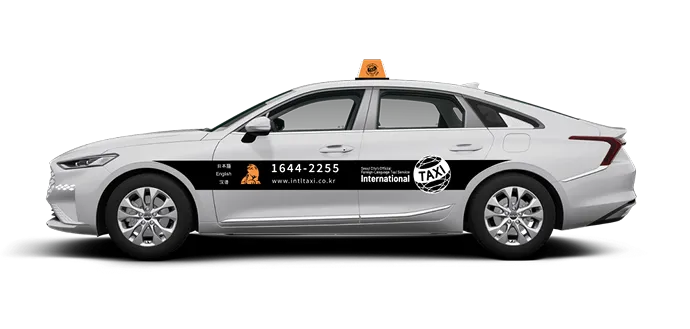
An International Taxi vehicle, as shown on the operator’s website. Image: International Taxi (Seoul Smart Co., Ltd.), intltaxi.co.kr.
For a fixed Incheon Airport ↔ Seoul run, International Taxi publishes zone fares instead of a metered guess, tolls included:
| Zone | Destinations | Standard | Deluxe/large |
|---|---|---|---|
| A | Gangseo | ₩70,000 | ₩100,000 |
| B | Yangcheon, Guro, Yeongdeungpo, Mapo, Eunpyeong, Seodaemun | ₩75,000 | ₩110,000 |
| C | Geumcheon, Gwanak, Dongjak, Yongsan, Jung, Jongno | ₩85,000 | ₩120,000 |
| D | Seocho, Gangnam, Seongdong, Dongdaemun, Seongbuk, Gangbuk | ₩90,000 | ₩130,000 |
| E | Songpa, Gangdong, Gwangjin, Jungnang, Nowon, Dobong | ₩95,000 | ₩140,000 |
Payment is cash in KRW or a credit card — VISA, AMEX, Mastercard, and others. The operator’s own current site says reservations must be made at least 24 hours in advance and describes online booking as the first step; its information booths at Incheon Terminal 1 and 2 are where it sends you for immediate assistance. The site now also shows app-store download links, but what that app does was not checked. Seoul’s own page describes a passenger app with home-country card registration. Either way, book ahead rather than expecting to flag one down.
On any other taxi, that 20% doesn’t apply — but not because a source names a foreigner exception. It’s because Seoul’s rule makes anything charged above the meter, outside an approved separate tariff, an unfair fare. Its fines run on the same ₩200,000-to-₩600,000 scale that covers a refused card, but the licence sanctions are heavier: a warning, then a 30-day suspension, then revocation, against 10 and 20 days’ suspension for a refused card. International Taxi is the one approved tariff that carries that extra 20%. A driver adding it to an ordinary metered ride isn’t charging a special rate — they’re charging an unfair one.
No Korean phone number? Here’s what’s actually documented
Kakao T — which Kakao Mobility itself calls Korea’s No.1 taxi service — is the one this guide cannot settle for a foreign number: no Kakao Mobility page cited here says either that a non-Korean number works or that it doesn’t, so neither can be said.
k.ride is the app Kakao Mobility built for foreigners: sign up with Google, Apple, or email, pay with an overseas-issued card, with English, Japanese, and Chinese support and a fare estimate shown before you hail. That sign-up route is stated on the Korean-language version of Kakao Mobility’s own site, which does not say whether a phone number is also asked for; k.ride’s English-language landing page describes the payment method but does not explain sign-up.

The k.ride app icon, as shown on Kakao Mobility’s website. Image: Kakao Mobility Corp., kakaomobility.com/k-ride.
Uber Taxi is the simplest option if you already have the app. The operator lists it as running in six Korean cities — Busan, Daegu, Daejeon, Incheon, Seoul, and Ulsan — with an upfront fare estimate shown before you request one, on the same account and payment method you already use.
Calling one without an app, and what to do if something goes wrong
Seoul also runs a phone-hailed option with no app at all: call 02-120 and press 6 for 120 동행콜택시, give your origin and destination, and dispatch details arrive by KakaoTalk or SMS. There is no separate call fee; the service is open to any citizen, with older and digitally excluded users given priority, and it’s operated by Tmoney Mobility. Seoul’s own page states operating hours of 09:00–22:00 in its body text — though its own poster graphic for the same service says 08:00–22:00. Whichever figure is right, it doesn’t run overnight, so it isn’t a late-night option.
If you think you’ve been overcharged, or refused a card or a receipt, keep the receipt, note the vehicle number, and report it. Seoul’s Taxi Policy Division handles refusal-to-carry and a foreign visitor’s unfair-fare complaint directly — everything else goes to the district office — and the city states an 8-week average processing time. A Seoul announcement from 2025 says QR survey cards in English, Chinese, and Japanese are handed out from 2025-06-19 at the Incheon and Gimpo departure areas, so a departing visitor can report meter non-use or overcharging on the way out; this guide has not confirmed the scheme is still running. One thing Seoul doesn’t do: refund you. The city states it issues administrative sanctions only, and directs anyone chasing money back to the taxi association or the operating company. Traffic complaints go to 02-120 and tourism enquiries to 1330.
Before you get in, have your accommodation’s Korean name and address ready — ideally as a screenshot; see apps to set up before you fly for how to do that before you land. The city, the hour, and the boundary you’re crossing decide the fare here far more than anything printed on the sign.