Most late-arrival advice answers the wrong question. It tells you what time the last train leaves, as if you were standing on the platform when you land. You are not. You are somewhere behind immigration with a phone down to single digits, and the number that decides your night is how long you will be stuck there.
Start with the only number that matters
Not your landing time. The time you will actually walk out into the arrivals hall.
Here is the part that changes the plan: Incheon Airport does publish a planning figure, and it is a wide one. Its Bus Stop Guide pages for both terminals tell anyone booking onward public transport to consider “the time required for immigration after flight arrival (1–2 hours)”. Its Arrival Procedures page lists the steps — information and declaration, immigration, baggage claim, arrival hall — with no durations attached. The airport also runs a live wait-time page, but it covers Terminal 1 departure security and will not tell an arriving passenger anything. Its Expected Airport Congestion page is closer to useful: it carries an hourly forecast of arrival-hall passenger numbers by terminal.
The range is not padding. The Korea Times has reported immigration stretching to as long as 1 hour and 54 minutes during the Lunar New Year holiday, and it names a reduced number of staff at entry checkpoints as one driver. So plan on the top of the airport’s range: give it 2 hours. That is my advice, not an airport instruction. The range is for immigration, and baggage claim comes after it on the airport’s list of steps with no time given, so add your own allowance for the carousel. The airport’s Korean page words the range as 입국 소요시간 and its Japanese page as 入国するまでの所要時間, both closer to “time until entry”, which could be read to include baggage claim. I take the narrower English reading and add baggage on top, which is the safer way to plan.
Take your landing time, add that buffer, and use the result for every decision below. One thing to flag before you do the math: AREX does not run until midnight for both of its trains — the faster one stops well earlier, and the next section gives the exact time. If your answer lands anywhere in the evening, keep reading. If it lands well before evening, you want the daytime airport transfer guide instead — that decision is a different one.
The rail cutoff
The two AREX products do not stop at the same time, and the gap is large enough to strand you. The last Express toward Seoul leaves Terminal 2 at 22:40 and Terminal 1 at 22:48, reaching Seoul Station at 23:31 — call it 80 minutes before midnight, not “around midnight.” If your buffer above lands at or after 22:40, do not plan on catching it.
The All-Stop runs later than the Express, and the operator’s own timetable does print an exact last minute — it just hides a trap in it. The last All-Stop that reaches Seoul Station leaves Terminal 2 at 23:32 and Terminal 1 at 23:38. A later departure exists, Terminal 2 23:50 and Terminal 1 23:56, and it terminates at Digital Media City — three stops short of Seoul Station and one short of Hongik Univ. If you are counting on that last one to get you all the way in, it will not. Confirm on the operator’s timetable before you fly: this guide’s minutes are only as current as the date they were checked.
What is worth knowing before you get there is that the two AREX products are genuinely different purchases:
| Express (직통열차) | All-Stop (일반열차) | |
|---|---|---|
| Route | Nonstop, Seoul Station to Terminal 1 then Terminal 2 | All 14 stations |
| Journey | 43 min to T1, 51 min to T2 | Longer, varies by stop |
| Adult fare | ₩13,000 | ₩4,750 from T1, ₩5,350 from T2 |
| Child fare | ₩9,500 | Reduced, by age band |
| Ticket | Bought separately before boarding | Tap a transit card |
| Last train toward Seoul | 22:40 from T2, 22:48 from T1 | 23:32 from T2, 23:38 from T1 (a later departure ends short at Digital Media City) |
Two rows there need reading twice. The All-Stop is priced station to station, so there is no single All-Stop fare — Terminal 2 costs ₩600 more than Terminal 1 to Seoul Station and to every stop from Unseo to Seoul Station, while to Airport Cargo Terminal the fare is the same from both terminals, ₩1,200. The figures above are to Seoul Station. The Express ticket is ₩13,000 whichever terminal you board at. Child fares on the All-Stop are worked out from the adult fare by age band rather than being a flat number, and the daytime transfer guide has both the full matrix and the age rules.
The ticket row catches people out. The Express cannot be ridden on a tapped card — you buy a ticket at the customer centre, at Seoul Station B2 or the B1 Transportation Centre at either terminal. If you were counting on tapping through with a transit card, that works for the All-Stop and not for the Express.
Night buses: the branch most people miss
When rail has stopped, the airport’s own pages list scheduled overnight buses into Seoul, run by Airport Limousine (N6000, N6002) and Korea Airport Limousine (N6701, N6703). Four routes:
| Route | Ends at | Adult | Child | First (T2) | Last (T2) |
|---|---|---|---|---|---|
| N6000 | Gangnam Express Bus Terminal | ₩17,000 | ₩10,000 | 23:50 | 04:00 |
| N6002 | Cheongnyangni | ₩17,000 | ₩10,000 | 23:40 | 04:20 |
| N6701 | Dongdaemun Design Plaza | ₩18,000 | ₩12,000 | 23:30 | 04:20 |
| N6703 | Gwangnaru | ₩18,000 | ₩12,000 | 23:20 | 04:30 |
Four things about that table.
Terminal 2 boards first. These are the Terminal 2 times. Terminal 1 boards 20 minutes later, which is either a comfort or a trap depending on which terminal you are standing in. Confirm your own terminal’s times rather than borrowing the ones above.
The last departures from Terminal 1 are N6000 at 04:20, N6002 at 04:40, N6701 at 04:40 and N6703 at 04:50. That makes the 04:20 in the table the last N6002 from Terminal 2, not from Terminal 1, where the last one leaves 20 minutes later.
Where you board depends on the terminal. At Terminal 2, boarding is at the B1 Transportation Centre bus terminal, the same level as the trains. At Terminal 1, the night buses board outside on the 1st-floor arrivals level: stop 3B for N6701 and N6703, stop 6A for N6000 and N6002. Neither is the departures kerb.
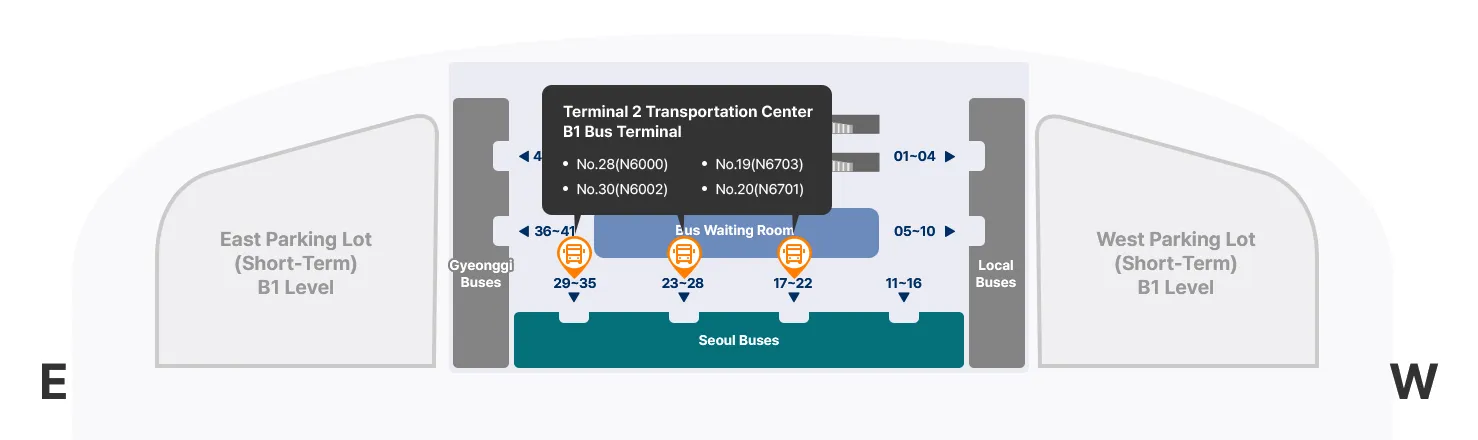
Terminal 2 late-night bus stop map, as shown on the airport’s Seoul Late-night Buses page. Image: Incheon International Airport Corporation, airport.kr.
Buy before you board. N6000 and N6002 sell through ticket booths and automated machines only. N6701 and N6703 add the Tmoney GO app, which is the one to set up before you fly if you would rather not find a working machine at one in the morning. Note what is not on that list for any of the four routes: there is no published instruction that you can simply tap a transit card on the way in. Do not plan on it.
The airport’s page lists those ways to buy but does not say in so many words that you must buy first. When I checked Terminal 1 on 2 October 2026, a banner beside the bus ticket kiosks on the 1st-floor arrivals level did say so in Korean: 심야버스는 매표소에서 승차권 발매 후 탑승하실 수 있습니다, meaning night buses can be boarded after a ticket is issued at the ticket booth. That wording is from the banner, not from the airport’s page, and the banner does not mention the app.
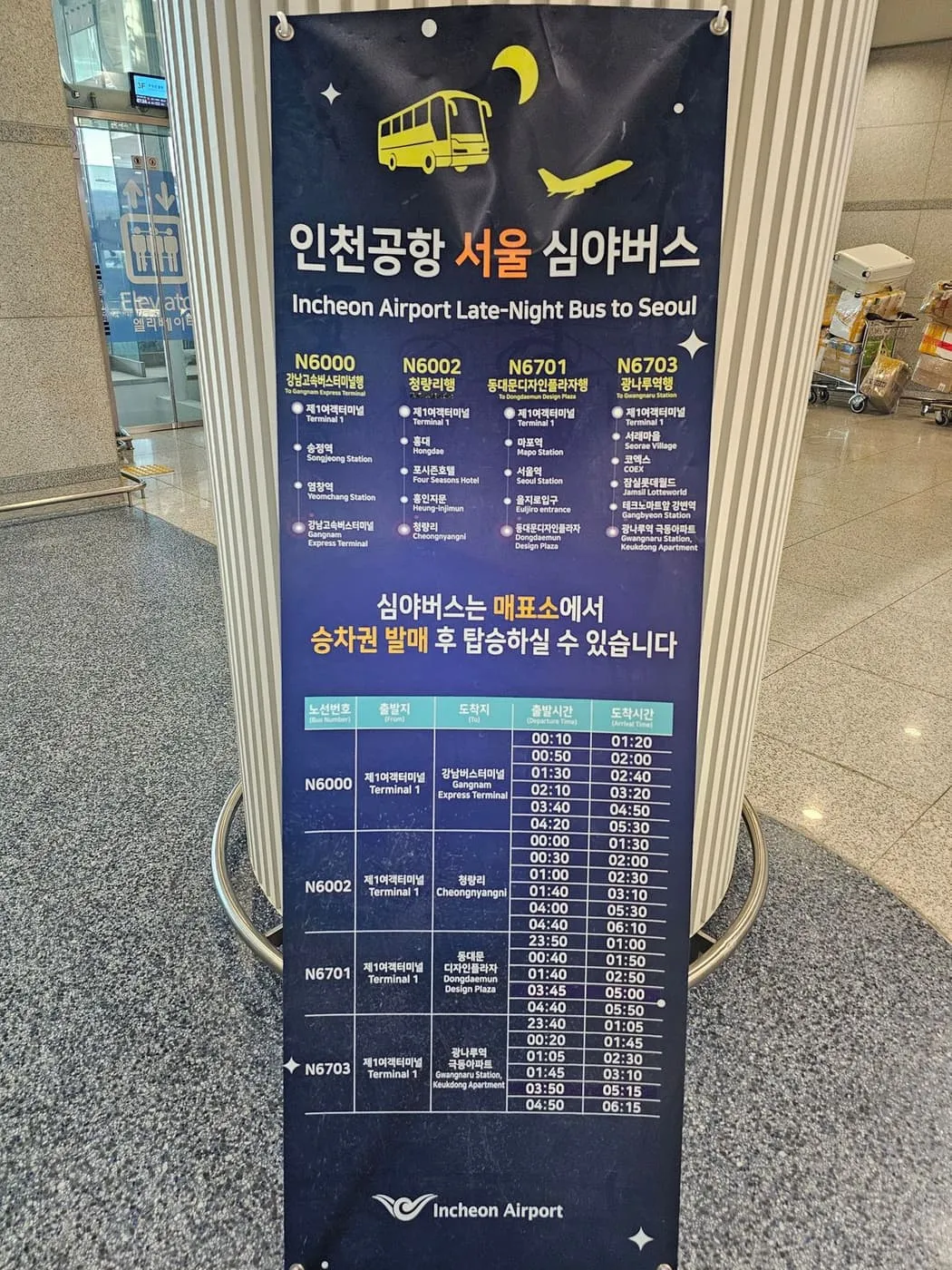
What the late-night bus banner showed at Incheon Airport Terminal 1 on 2 October 2026. Photograph by the author.
Get off at the right stop, not the right district. A route ending at Cheongnyangni passes places that are not Cheongnyangni. Put your accommodation into NAVER Map, find the stop nearest the actual entrance, and screenshot the walk. At 2am, a fifteen-minute walk you did not expect is a much bigger deal than it looks on a map.
One cheaper case worth knowing: N6000 charges ₩10,000 adult and ₩6,000 child if you are only going as far as Songjeong Station.
If your destination is outside Seoul, these are the wrong buses. Separate Gyeonggi Province night routes run from both terminals through the small hours, and their fares vary by distance rather than sitting at a fixed price. Use the airport’s bus search to find yours.
Taxi: read the surcharge before you queue
The ranks operate around the clock. I will be straight with you about that one: the airport’s taxi page does not publish operating hours in either Korean or English, so I am telling you what I know from living here rather than something I can link you to. The surcharges, stand numbers and the call-van warning are on the official page, and its English version also carries a live “Waiting Information” count of available taxis per terminal, which is the nearest thing to a check you can make on the night.
The night surcharge is not one number. It depends on where you are going.
| Taxi | Destination | Surcharge |
|---|---|---|
| Standard | Seoul, Incheon | 20% (22:00–23:00) · 40% (23:00–02:00) · 20% (02:00–04:00) |
| Standard | Gyeonggi taxi (Bucheon, Gwangmyeong, Gimpo, Goyang) | 30% flat, 23:00–04:00 |
| Deluxe / jumbo (9-seat) | Any | 20% (22:00–04:00), Gyeonggi taxis 23:00–04:00 |
The Gyeonggi row covers those four cities only. For any other destination the airport draws a separate Out-of-Town stand at Terminal 2 (5C), and it attaches a boundary surcharge on top, which its taxi page sets out.
Base fares are ₩4,800 standard and ₩7,000 deluxe. Those are meter start figures, not what you will pay to Seoul. The total is metered and considerably higher.
The stands are numbered, and the number depends on your destination as well as your terminal. At Terminal 1, standard taxis queue at 5C, 6C and 6D; deluxe and jumbo at 7C and 8C. At Terminal 2, the split is by region: Seoul at 7C, Gyeonggi at 6D (those four cities only), Incheon at 5D, with deluxe and jumbo at 7D and out-of-town destinations at 5C. International and Smart Taxi — the officially designated foreign-language service — is 4C at Terminal 1 and 3C at Terminal 2.
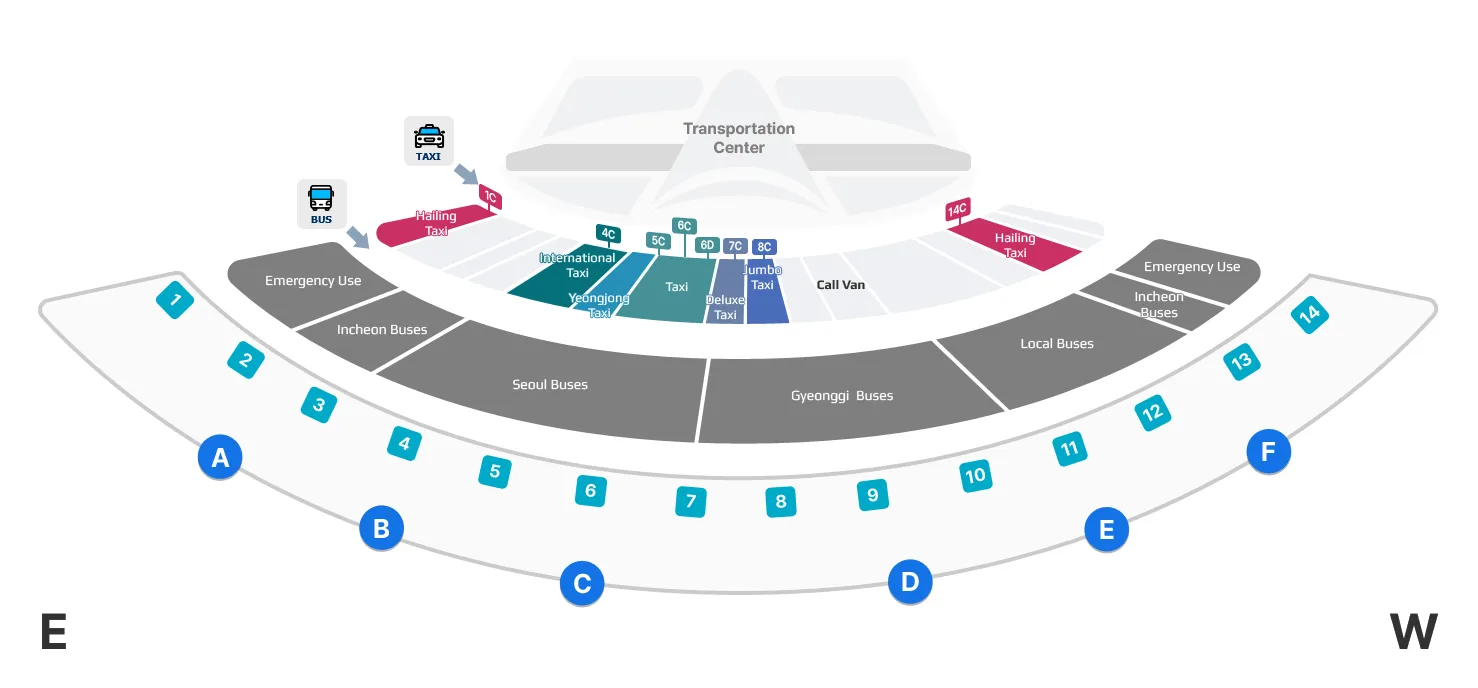
Terminal 1 taxi stand map, as shown on the airport’s Taxi Guide page. Image: Incheon International Airport Corporation, airport.kr.
The airport warns, in its own words, that call vans posing as taxis solicit passengers and overcharge them. Walk to the signed rank. If someone approaches you inside the terminal offering a ride, that is the thing being warned about.
Have the Korean address and phone number of your accommodation ready as a screenshot before you get in. English hotel names are not reliably unique here, and a Korean address or a dropped map pin gives the driver something exact.
When waiting is the right answer
If you clear arrivals in the small hours, waiting for the first train can beat a surcharged taxi: for standard taxis to Seoul or Incheon the surcharge is 40% until 02:00 and 20% until 04:00. Before you go looking for somewhere to do it, check which side of passport control a place sits on. The airport’s English facility directory marks some entries “Public Area” or “Duty Free Zone”, but not the Darakhyu entry.
The Transit Hotel and the NAP, Relax and Refresh zones are listed on Terminal 1’s fourth floor, in the transit area. If you have cleared immigration and collected your bags, you are on the other side of it, and you cannot go back through. The one I can put you in front of is Capsule Hotel Darakhyu, because its operator places it itself — in the “Normal Area” of Terminal 1’s Transportation Centre, the same building as the trains, open 00:00–24:00. The airport’s English directory labels that floor 1BF while the operator calls it the Transportation Centre’s first floor; both are right, so navigate by the building rather than the number.
Walkerhill publishes its rates on each room page, including VAT. On 26 September 2026 the overnight rate (20:00 to 08:00, 12 hours from check-in) read KRW 69,000 to KRW 94,000 depending on the room, and the operator says the table is a weekday rate that can change at weekends and on public holidays. Check the room page for the night you land.
Landside seating and a nearby stay are the other two options, and none of these is a failure of planning.
The maths is simple enough to do standing up: a surcharged taxi across Seoul against a few hours in the terminal and a ₩4,750 train from Terminal 1, or ₩5,350 from Terminal 2. Some nights the taxi is obviously worth it. Some nights it very obviously is not.
Before you leave the arrivals hall
Sixty seconds, while you still have signal and a place to stand:
- The route you have chosen, with the stop nearest your door.
- One backup, in case the last one has gone.
- Your accommodation’s name and address in Korean.
- A screenshot of the final stop and the walk from it.
The version of this that goes wrong is not the one where you pick the wrong bus. It is the one where you pick correctly, arrive at the right stop, and then discover at 3am that you cannot show anyone where you are trying to go.
I check this guide against the official pages linked below, and fares and departure times move. If something here no longer matches what you found, tell me — that is genuinely the fastest way it gets fixed.