Open your hotel pin before buying a ticket. “Incheon Airport to Seoul” sounds like one journey. It is not — Seoul is large enough that the wrong fast train hands you a slow, awkward transfer at the other end, and that is the mistake I most want you to avoid on your first night.
Pick by hotel, not headline travel time
| If you are staying… | Start with… | Why |
|---|---|---|
| On or near the airport line | AREX All-Stop (일반열차) | Cheapest, and often no second train |
| Near Seoul Station | AREX Express (직통열차) | Reserved seat, no intermediate stops |
| Close to a limousine bus stop | Airport limousine (공항리무진) | Less lifting, fewer station corridors |
| Somewhere awkward, travelling as a group | Official taxi rank | Splitting the fare can make door-to-door reasonable |
This is a starting rule, not a promise. Put the exact accommodation address into NAVER Map and count transfers, stairs, and the final walk. Stairs with a suitcase are the variable people forget.
Terminal 2 is not the same trip as Terminal 1
Check your boarding pass before anything else. On both AREX trains Terminal 2 is the longer ride, and on the All-Stop it is the dearer one too; the Express adult fare is the same from either terminal. The airport’s Bus Search panel and Taxi Guide page give no fare or journey time by terminal (the panel lists departures for each terminal, but not how long the ride takes), so this page makes no terminal-by-terminal comparison for the bus or the taxi.
On the All-Stop train, every destination from Seoul Station to Unseo costs ₩600 more from Terminal 2. The one exception is the Airport Cargo Terminal, which is ₩1,200 from either terminal. The difference is small, but it is a reliable signal of the pattern on that line: Terminal 2 sits further out, so the Express takes 8 minutes longer too. When a guide quotes one train fare for “Incheon Airport,” check which terminal it is for.
The two AREX trains are different products
This is the distinction that catches people, and it is not about speed.
| Express (직통열차) | All-Stop (일반열차) | |
|---|---|---|
| Route | Nonstop to Seoul Station | All 14 stations |
| Journey | 43 min from T1, 51 min from T2 | To Seoul Station, 59 min from T1, 66 min from T2; some trains take 2–6 minutes longer |
| Adult fare | ₩13,000 | ₩4,750 from T1, ₩5,350 from T2 |
| Child fare | ₩9,500 | Reduced, see below |
| Ticket | Bought separately before boarding | Tap a transit card |
The Express cannot be ridden on a tapped card. You buy a ticket at the customer centre — Seoul Station B2, or the B1 Transportation Centre at either terminal — and it is a reserved seat.
When I checked Terminal 1 on 2 October 2026, the floor directory listed Arrivals on 1F with a Bus and Taxi icon, and gave “Way to Airport Railroad & Parking” on both 2F and B1. It does not mark the Express counter, so the B1 Transportation Centre above stays the place to look.
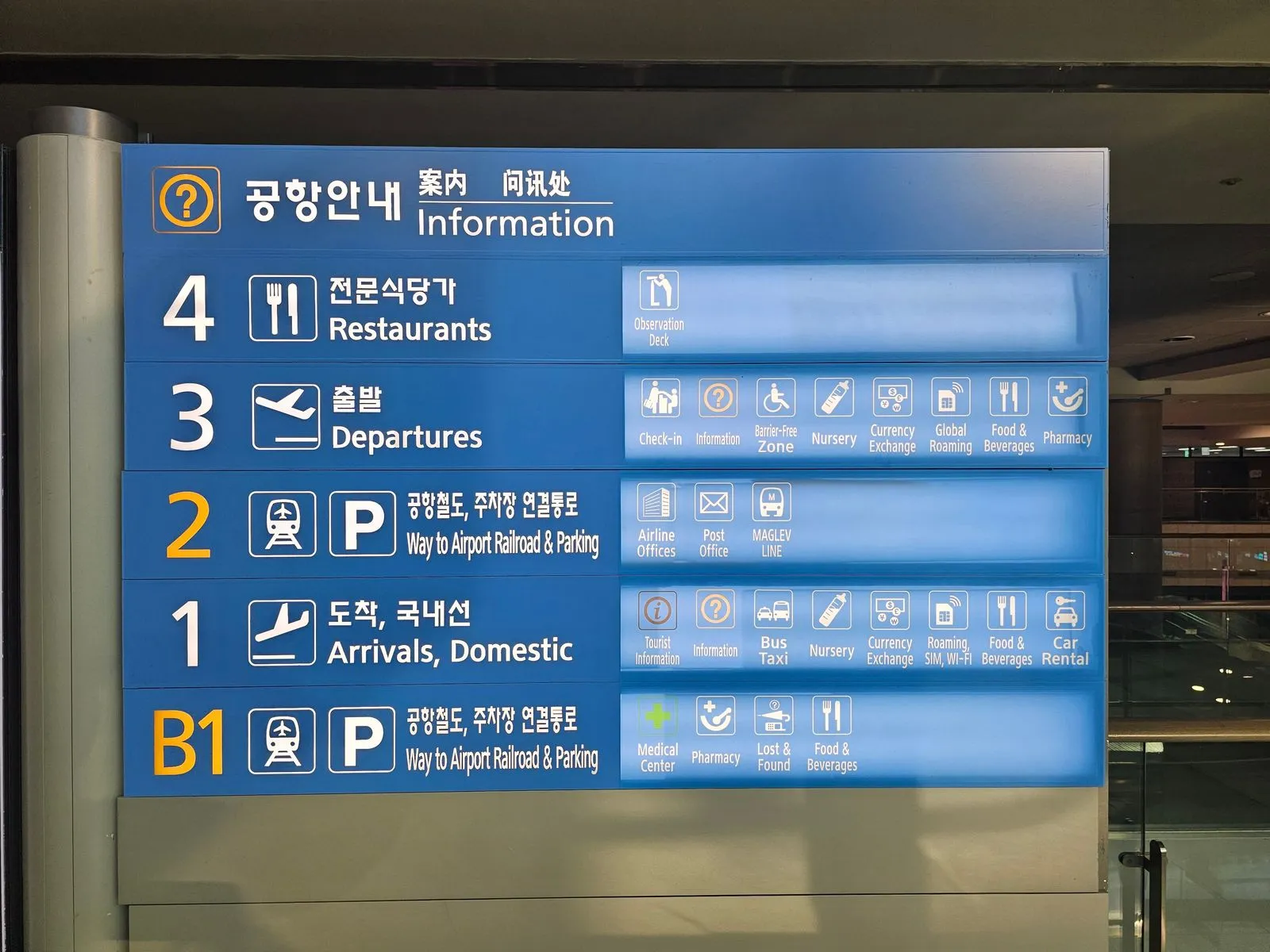
What the floor directory showed at Incheon Airport Terminal 1 on 2 October 2026. Photograph by the author.
The All-Stop is the ordinary urban service, and for most first visits it is the right answer. Adult fares on a transit card:
| Destination | From T1 | From T2 |
|---|---|---|
| Seoul Station (서울역) | ₩4,750 | ₩5,350 |
| Hongik University (홍대입구) | ₩4,650 | ₩5,250 |
| Gongdeok (공덕) | ₩4,650 | ₩5,250 |
| Digital Media City | ₩4,550 | ₩5,150 |
| Gimpo Airport (김포공항) | ₩4,350 | ₩4,950 |
A single-journey card adds ₩100 and takes a ₩500 deposit, refunded at the arrival station. Children aged 6–12 pay a ₩550 base plus half the added fare; youths aged 13 to 18 pay a ₩900 base plus 80% of the added fare.
Look at what the fares actually say. To reach Seoul Station, the Express costs nearly three times the All-Stop from Terminal 1 and roughly two and a half times from Terminal 2. It is worth it when you want a guaranteed seat with luggage after a long flight, or when Seoul Station itself is your destination. It is not worth it to save time you will lose again transferring at the other end.
You will need a transit card for the All-Stop. Note one trap there: the Climate Card cannot board AREX at the airport terminals, so it is not the card to arrive on. To price a ride to a station that is not in the table, the Seoul subway fare calculator gives an All-Stop fare from either terminal; it does not price the Express.
The bus is a real option, and the fare is one click deeper
Airport buses are slower when road traffic is heavy. They are also underrated when a bus stops on the same block as your hotel and the rail alternative involves two transfers and a lift that is out of service.
Incheon Airport runs an official bus route search by destination region — the page this guide links to below. That landing page, and the results list the search returns, show route names only: no fare, no boarding stop. Click a route name and a panel opens one step deeper, with the fare, first and last bus, and the boarding stop at each terminal. Route 6002 (Airport Limousine), for example, publishes a fare of ₩17,000, boarding at Terminal 1 (level 1, stop 6) and Terminal 2 (Transportation Centre basement 1, stop 30) — that route’s own figures, not a flat “airport bus” price, since the fare is set route by route.
Two things to watch for once that panel is open. The Terminal 1 boarding line sometimes prints the Korean word for floor instead of translating it — read “1층” as “1st floor” if it turns up next to your stop number. And the destination search is picky about spelling: an English name can return a different, incomplete set of routes depending on how you spell it, while the Korean name returns the full list. Try more than one spelling, or the Korean name if you have it, before deciding a route does not exist.
Use the search on the day you travel, and confirm three things:
- Terminal 1 or Terminal 2 — routes and times differ.
- The stop nearest the hotel entrance, not merely the same district.
- The final departure, allowing for immigration and baggage.
If you are heading outside Seoul, the airport points to two booking sites, split by route rather than by coach type: txbus.t-money.co.kr for intercity coaches on every route except Gimhae, and kobus.co.kr for the Gimhae route.
When I checked Terminal 1 on 2 October 2026, the arrivals hall had a row of self-service ticket kiosks under a 버스매표소 BUS TICKETS sign, and a blue sign with an arrow pointing left to a staffed 공항버스 유인매표소 Airport bus Ticket Office. I am printing no fare or hours from that frame.
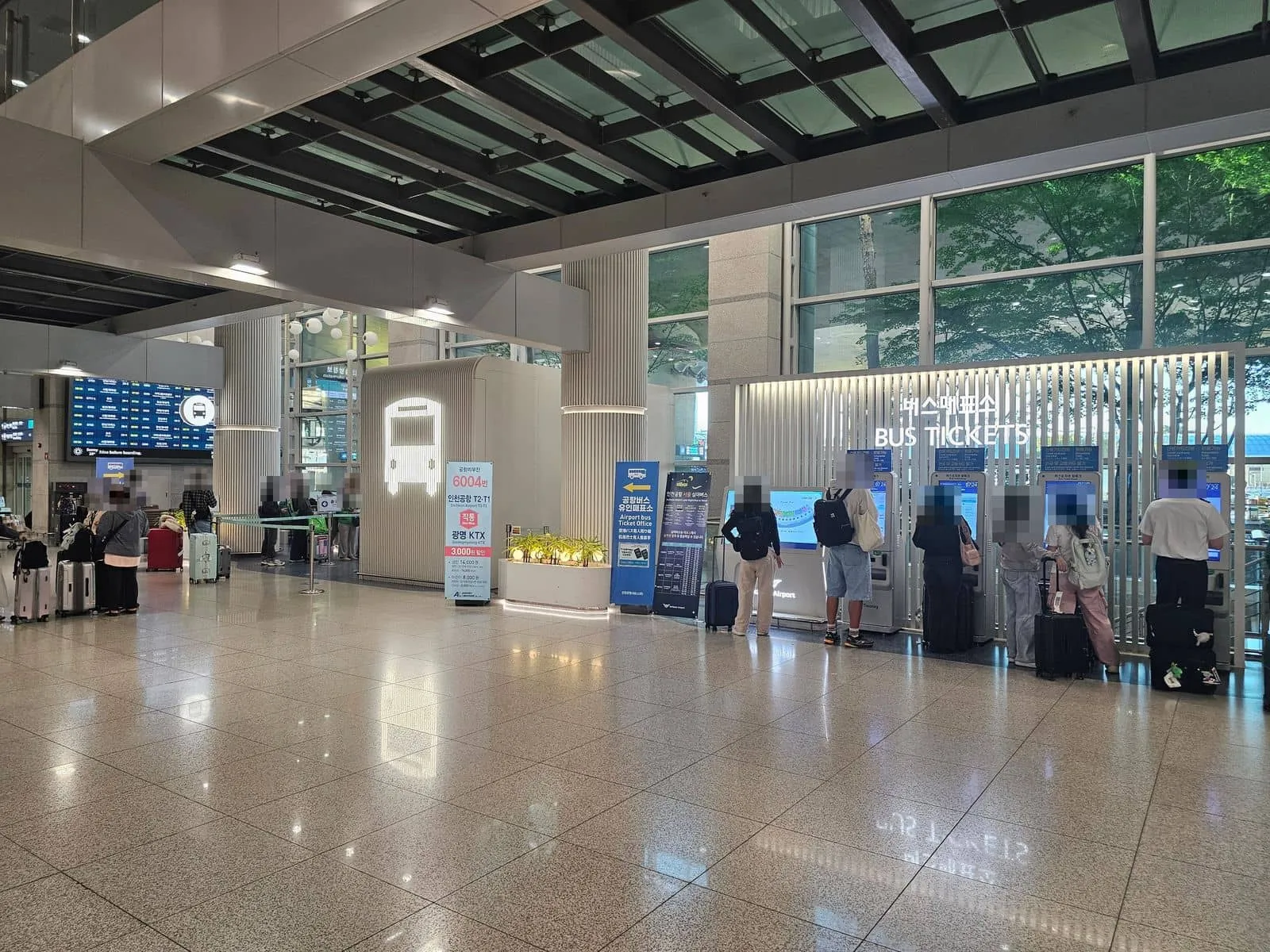
The bus ticket area in the arrivals hall at Incheon Airport Terminal 1 on 2 October 2026. Photograph by the author.
Taxi: the number on the sign is not the fare
Follow the airport signs to the official rank. The stands are numbered, and the number depends on where you are going as well as which terminal you are in.
At Terminal 1, standard taxis for Seoul, Incheon and Gyeonggi share one set of stands, 5C, 6C and 6D; deluxe and jumbo are at 7C and 8C, and pre-booked hailing taxis are at 1C and 14C. At Terminal 2 the split is by region: Seoul at 7C, Gyeonggi at 6D, Incheon at 5D, with deluxe and jumbo at 7D. The Gyeonggi stand is limited to Bucheon, Gwangmyeong, Gimpo and Goyang. The airport’s map marks a separate Out-of-Town Taxi stand at 5C, and its table lists other destinations as their own category, so for anywhere else in Gyeonggi do not simply join the 6D line. International and Smart Taxi — the officially designated foreign-language service — is 4C at Terminal 1 and 3C at Terminal 2, and the airport says a flat fare applies for rides into Seoul.
When I checked Terminal 1 on 2 October 2026, the transport map beside an exit placed the taxi stands across the crosswalk from the 1F exits, and the 4C pillar posted International Taxi flat fares to Seoul by zone, toll included. That board lists International Taxi at “4C 4D”, while the airport’s Taxi Guide gives 4C only; head for 4C. The map also draws a Yeongjong Taxi stand, but the airport’s English pages give it no stand number, so I am not giving one either.
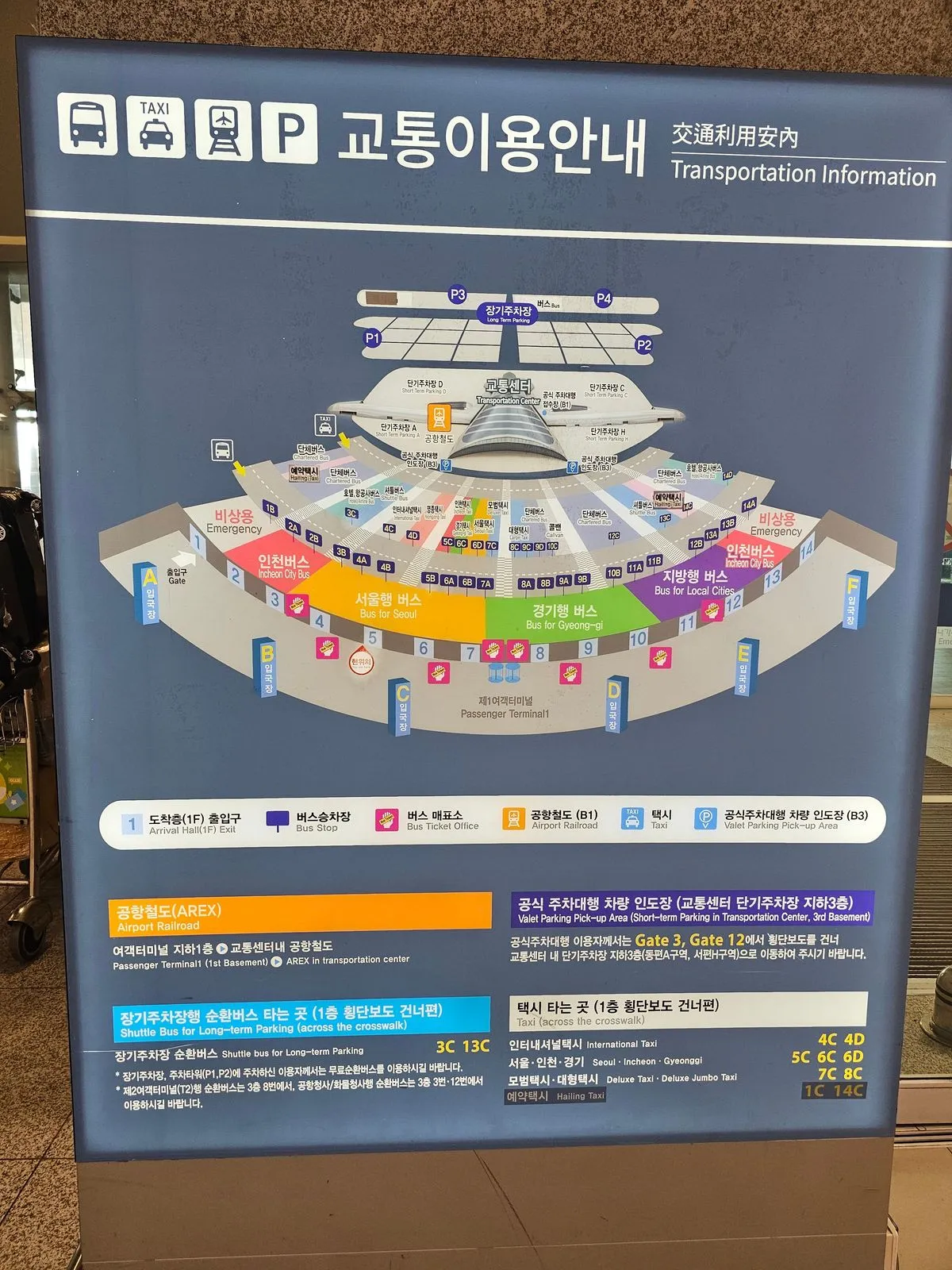
What the transport map beside an exit showed at Incheon Airport Terminal 1 on 2 October 2026. Photograph by the author.
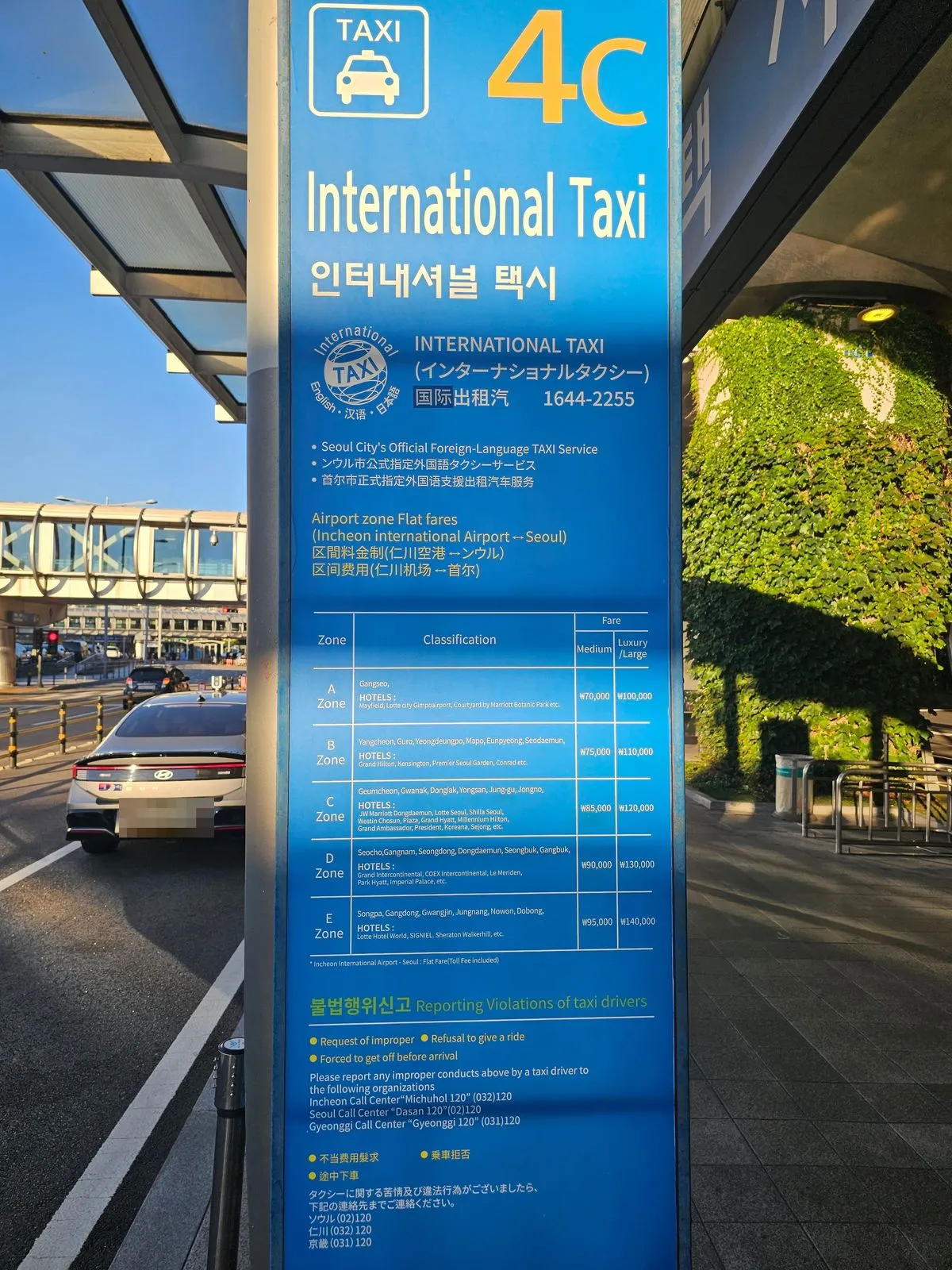
What the 4C International Taxi pillar showed at Incheon Airport Terminal 1 on 2 October 2026. Photograph by the author.
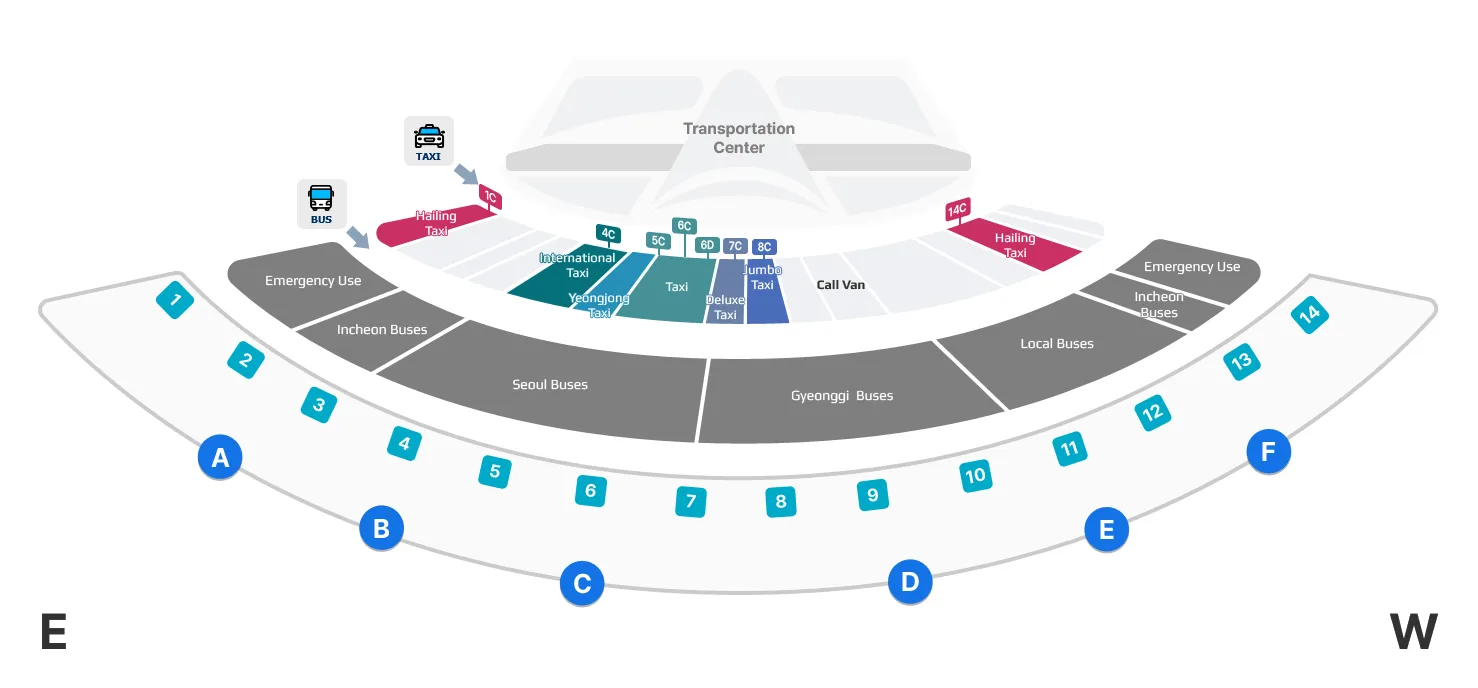
Terminal 1 taxi stand map, as shown on the airport’s Taxi Guide page. Image: Incheon International Airport Corporation, airport.kr.
Base fares are ₩4,800 for a standard taxi and ₩7,000 for deluxe or jumbo. Those are meter start figures. The airport’s Taxi Guide page publishes no estimate for a ride into Seoul, and the real total is considerably higher — this is a long trip, not a city hop. On 2 October 2026 the 4D pillar at Terminal 1 did post an estimate table by destination, and it says the meter sets the fare.
If you arrive late, the surcharge is not one number either. Going to Seoul or Incheon, a standard taxi adds 20% from 22:00, 40% from 23:00 to 02:00, then 20% until 04:00. A Gyeonggi taxi adds a flat 30% from 23:00 to 04:00. Deluxe and jumbo run 20% from 22:00 to 04:00 (Gyeonggi taxis: 23:00 to 04:00). For a ride that ends beyond Seoul, Incheon, Goyang, Gwangmyeong, Gimpo and Bucheon, the airport’s page also lists a city-boundary surcharge, applied from the point where the taxi leaves that area: 20% for Seoul and Gyeonggi taxis, 30% for Incheon taxis.
One disagreement on that grouping: the 4D pillar I read on 2 October 2026 lists Gwangmyeong taxis with Seoul’s night scheme, and only Bucheon, Gimpo and Goyang on the Gyeonggi 30% scheme. The airport’s page puts Gwangmyeong with Gyeonggi. If your ride involves a Gwangmyeong taxi, expect the meter to decide.
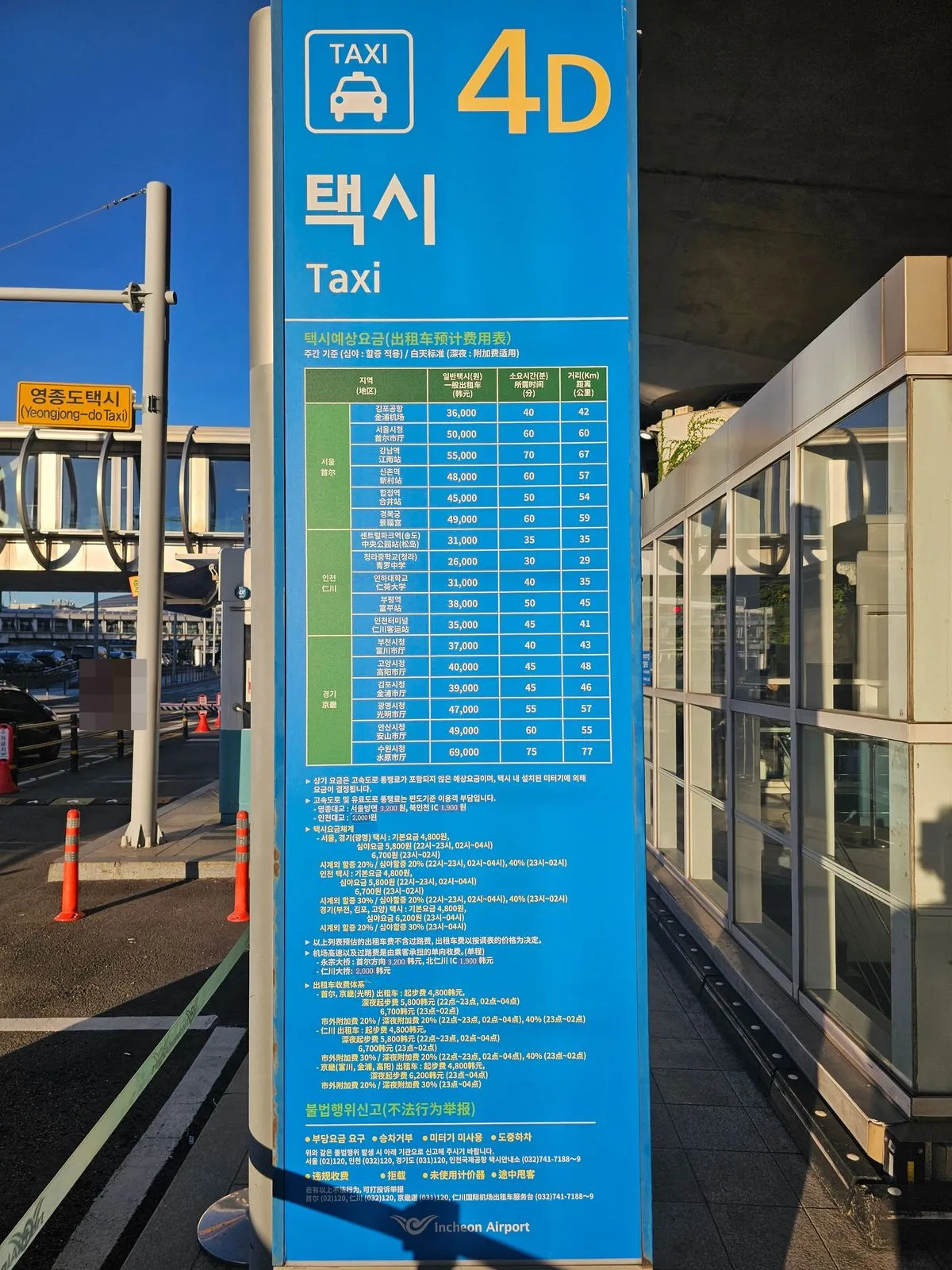
What the 4D taxi pillar showed at Incheon Airport Terminal 1 on 2 October 2026. Photograph by the author.
The airport warns, in its own words, that call vans posing as taxis solicit passengers and overcharge them. Walk to the signed rank. If someone approaches you inside the terminal offering a ride, that is the thing being warned about.
The ranks operate around the clock — I will be straight that the airport’s own page does not publish operating hours, so I am telling you what I know from living here rather than something I can link you to.
Save your accommodation’s Korean address and phone number as a screenshot before you get in. English hotel names are not reliably unique here.
How long before you can actually leave
Your landing time is not your departure time. The airport does publish a planning figure, and it is a wide one: its Bus Stop Guide pages for both terminals tell anyone booking public transport from the airport to allow for the time required for immigration after the flight lands, 1–2 hours. Its Arrival Procedures page lists the steps with no durations attached, and its live wait-time page covers Terminal 1 departure security, which tells an arriving passenger nothing. The Expected Airport Congestion page publishes an hourly arrival-hall passenger forecast by terminal. It gives passenger counts, not minutes, but it shows whether your landing hour is a busy one.
That range is for immigration. Baggage claim comes after immigration on the airport’s list of steps, with no time given. I would plan on the top of the range, 2 hours, and add your own allowance for the carousel; that is my advice, not an airport instruction. Add it to your landing time before you decide anything above.
The late-night fallback
The Express — the faster of the two trains — stops earlier in the evening: on the weekday and holiday timetables its last trains leave Terminal 2 at 22:40 and Terminal 1 at 22:48; the first leave at 05:16 and 05:24, and the two tables match. The All-Stop runs later. Its last departures to Seoul Station leave Terminal 2 at 23:32 and Terminal 1 at 23:38, and a later departure at 23:50 from Terminal 2 or 23:56 from Terminal 1 only goes as far as Digital Media City.
The airport also lists overnight bus routes into Seoul, run by Airport Limousine and Korea Airport Limousine. The first leaves Terminal 2 at 23:20, before the last All-Stop to Seoul Station, so you do not have to wait for both trains to stop.
If your arrival is anywhere near that cutoff, the decision changes enough to deserve its own page: arriving after the last train has the exact last-train time for both the Express and the All-Stop, the night buses, the taxi surcharge, and when waiting for first service is the better call.
Before you leave arrivals
Sixty seconds, while you still have signal and somewhere to stand:
- the route you intend to use, and one backup;
- your hotel name and address in Korean;
- a screenshot of the final stop and the walk from it.
When I checked Terminal 1 on 2 October 2026, the overhead sign at exit 5 pointed ahead to Bus, Taxi and Ground Parking, and to the right to the Airport Railroad. Read the sign over whichever exit you use.
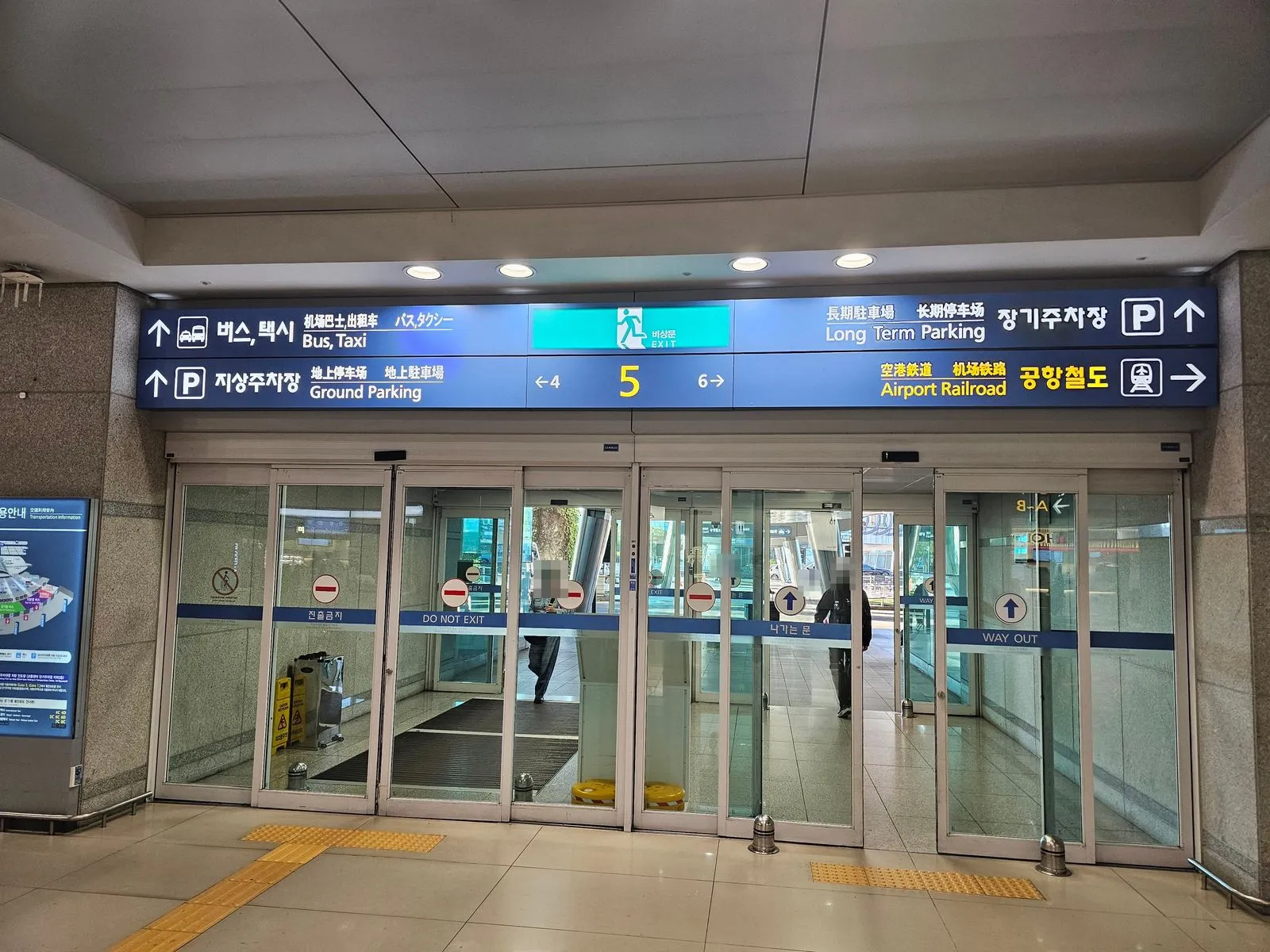
The overhead sign at exit 5 at Incheon Airport Terminal 1 on 2 October 2026. Photograph by the author.
My pick is always the route with the fewest fragile connections. The smallest number on a journey-time graphic is only part of that calculation, and it is never the part that goes wrong when you are tired.