Most write-ups about paying in Korea try to declare a winner between a foreign card, Korean-won cash, and a prepaid product like WOWPASS. That’s the wrong shape for the question. A foreign card is the ordinary way to pay here if your issuer is actually ready for it. Cash covers a short, specific list of places a card won’t reach. How you pay for transit is a separate decision from either one. None of the three needs ranking against the others — the fact that decides most of this trip is your own card issuer’s terms, and no Korea-specific source can supply those for you.
The costliest wrong assumption is narrower, and worth naming first: that an international card taps at a Seoul subway gate today. It doesn’t, and believing otherwise is how a visitor ends up stuck at a closed gate with a train to catch.
Transit is its own decision, and the gate isn’t ready yet
Since 17 March 2026, Seoul has accepted international Visa and Mastercard, along with Kakao Pay and Naver Pay, at the transit-card vending machines themselves — 440 machines across 273 subway stations on Lines 1 to 8, minus the Jinjeop section of Line 4, the Bucheon section of Line 7, and the Byeollae section of Line 8. You can use one of those cards at a machine to buy a Climate Card, recharge a 1, 2, 3, 5 or 7-day pass, or buy a single-journey ticket, at an average service fee the city describes as approximately 3.7%. The card operator, Tmoney, adds on its Korean-language Climate Card page that foreign-issued credit or debit cards may be restricted or carry a separate fee.
That’s the machine, not the gate. Seoul’s own open-loop payment plan — last revised 16 October 2025 — puts subway gate-terminal replacement in its second phase, targeted for 2027, after the first phase installs bus-terminal equipment and builds the payment back office. Nothing published says gate-tapping works today. Buy a Climate Card at one of the machines above. Seoul’s Korean-language information page for the card now lists short-term passes only, valid on the Seoul-area subway except the Sinbundang Line and GTX, for getting off at Incheon Airport’s Terminal 1 and Terminal 2, and on Seoul-licensed city and town buses; it excludes intercity and airport buses. Seoul’s English policy page names two ways to charge it: a charging kiosk inside a station, or the Mobile Tmoney app with the card tapped against the phone. That English page has not caught up with the Korean one and still shows the wider area and the 30-day passes. Cash covers a T-money top-up at a subway ticket machine or a convenience store (more under cash, below). See T-money or a Climate Card for which one actually fits your itinerary.
Your card is the default, if your issuer is ready
Korea’s own tourism authority describes cards as widely accepted at hotels, department stores and general shops, naming Visa, Mastercard and American Express — while adding its own caveat: check that a specific store takes cards before you rely on it, because some don’t. That describes the market, not a guarantee that your specific card will authorise at a specific terminal, and no source here can promise that.
Before you fly, the checking is on your issuer, not on Korea. Confirm overseas transactions are switched on, know your card’s foreign-transaction fee, and confirm your PIN and your issuer’s ATM withdrawal limit abroad — Visa’s travel guidance names three pre-trip checks: telling your issuer about the trip, your card’s daily ATM withdrawal limit and your PIN. On the fee, Mastercard’s FAQ says to contact the financial institution that issued your card to find out the currency conversion charges on foreign transactions.
Two mechanisms are worth understanding before you’re standing at a terminal. First, dynamic currency conversion: a merchant or ATM may offer to charge you in your home currency instead of won, using its own exchange rate plus a fee — Mastercard says outright that its currency conversion rates don’t apply when a merchant or ATM operator does the converting, Visa requires merchants and ATMs to display the exchange rate and any added fees or markup, and Visa’s own advice is to decline whenever the terms aren’t clearly disclosed or you feel rushed into it. Pay in won instead. Second, a credit card withdrawing cash abroad is typically treated as a cash advance by the issuer rather than an ordinary purchase, and can carry separate cash-advance, ATM and finance charges — a card-contract consequence that has nothing to do with which country you’re in.
Where cash still matters
Three specific situations call for won in hand, not a blanket reserve you carry just in case.
Some street stalls and underground shopping arcades take cash only. WOWPASS’s operator lists “cash-only places like street stalls or underground markets” among the places its card can’t be used, and its Korean page words it as stalls and arcades that accept only won cash. That is an example of cash-only places, not a claim that every stall or arcade refuses cards, so keep won for the ones that do.
The WOWPASS machines at Incheon Airport belong to the operator, Orange Square, not the airport. They sit in the CU convenience stores at Terminal 1 Branch 1 and Terminal 2 Branch 3, take Korean won cash and nothing else as funding, and don’t offer cash exchange or balance withdrawal at all. Don’t plan to land with foreign notes and convert them there, and don’t plan to cash out a balance there on the way home either.
Whether those machines will issue you a new card is where the operator’s own pages disagree. Its Korean FAQ marks card issuance, reissuance and top-up as available at the airport machines and cash exchange and withdrawal as not provided; its English FAQ puts all five in one bracketed list ending “Not Available”. I can’t tell you which page the machine follows, so don’t count on buying your first card there. Neither page gives opening hours, so I have none to give you. When I checked Terminal 1 on 2 October 2026, the tourist information desk on the first-floor arrivals level had a WOW PASS sign with an arrow reading “Near EXIT 2, at (CU)”. I did not see the machine itself, and no official page gives its exit number.
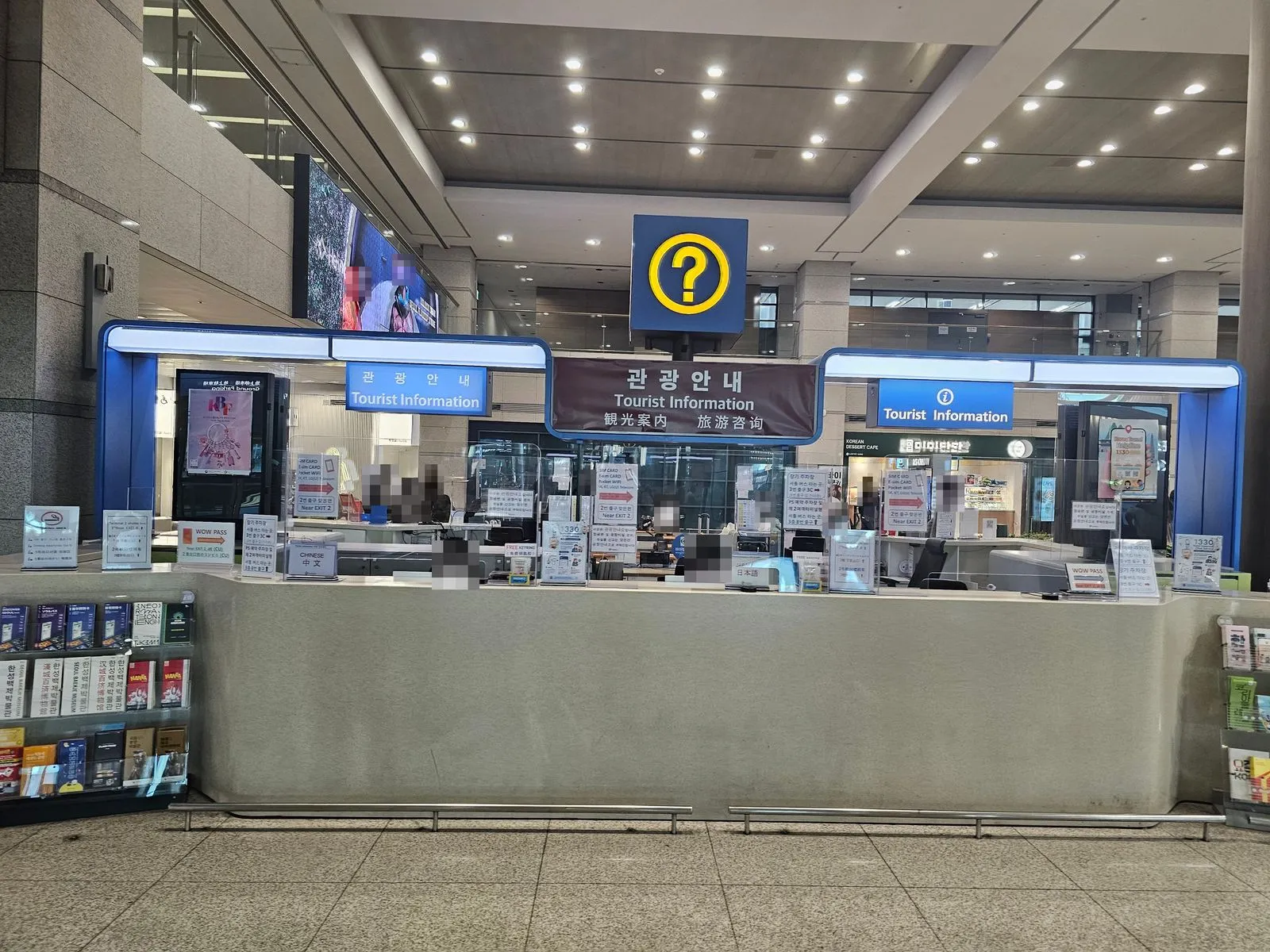
What the tourist information desk’s signs showed at Incheon Airport Terminal 1 on 2 October 2026. Photograph by the author.
And for a Tmoney top-up without the app, the offline route is cash: the operator’s FAQ names subway ticket machines and convenience stores as places that take won cash. A short-term Seoul pass is different: the vending machines above take international cards for that.
WOWPASS: an extra prepaid balance, not a card replacement
WOWPASS is a prepaid card, sold to foreign visitors, that holds a payment balance and — once you fund it — a separate Tmoney transport balance. Both editions of the operator’s own guide are explicit that the two balances don’t merge and have to be topped up separately, and the sources describe only one direction between them: the app can move money from your WOWPASS payment balance into your Tmoney balance by scanning the card, and no official source describes a route back. The one stated way to recover value stuck on the transport side is a refund through the allied transport-card issuer’s own process, which may itself carry a fee. My own inference, not the operator’s advice: load the Tmoney side in small amounts rather than all at once, since no official route back is published.
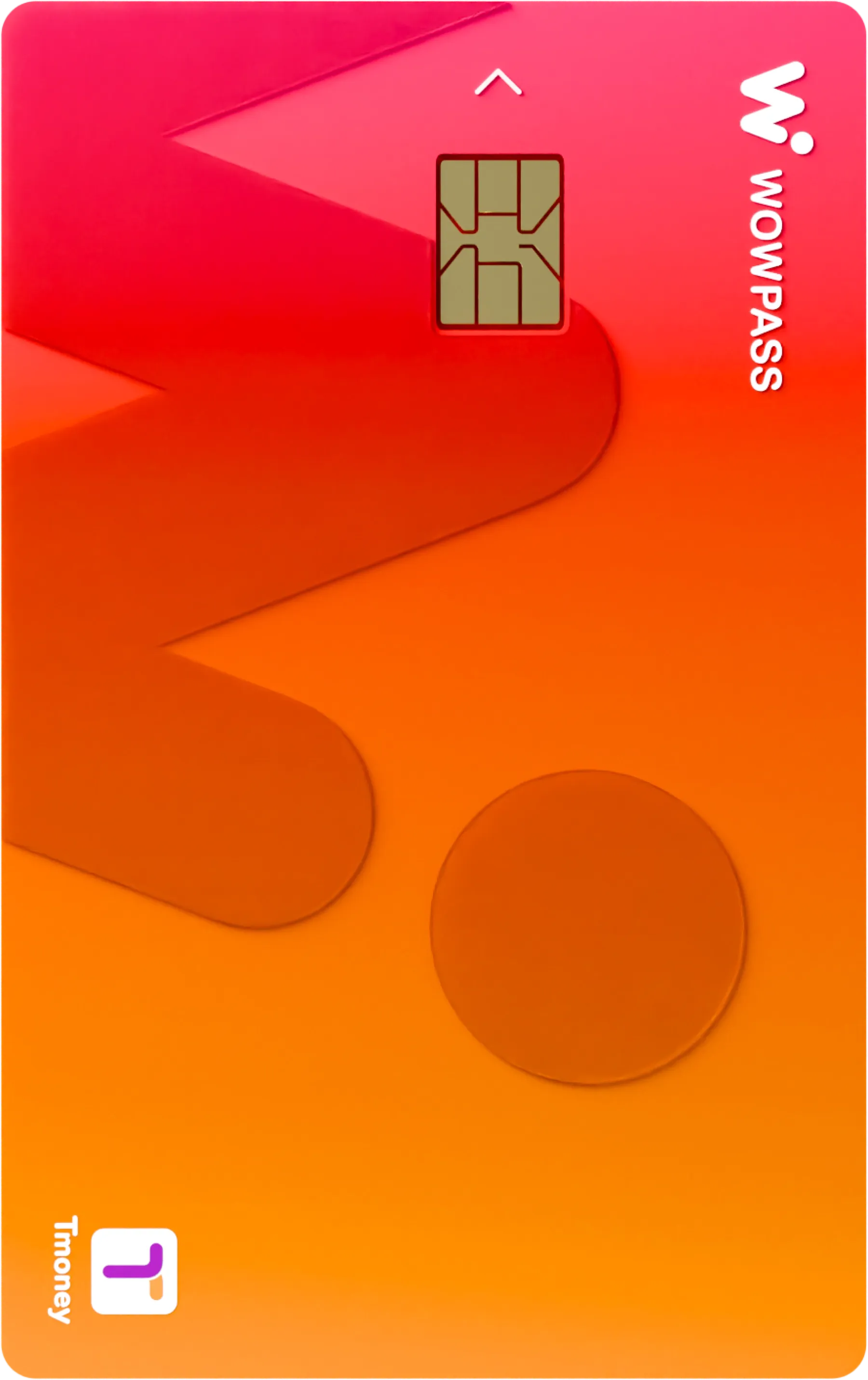
WOWPASS card, as shown on the operator’s website. Image: Orange Square Co., Ltd. (WOWPASS), wowpass.io.
You cannot price this product before you land. The service agreement reserves the right to charge card issuance, membership registration, cash withdrawal, reissuance, overseas-use and currency-exchange fees, says the amounts vary by card type and member, and defers every specific to the kiosk or the app — no fee schedule is published anywhere. What the operator does state is the cost of withdrawing your balance as cash at a WOWPASS machine: ₩1,000 per withdrawal, capped at ₩100,000 each time, repeatable, and the withdrawal itself needs the app — the card has to be registered and an 8-digit PIN shown on the kiosk entered there. The homepage advertises paying with zero fees; its own contract reserves six fee categories and its own FAQ concedes an app top-up “may” carry a fee it never quantifies. Treat the zero-fee line as marketing, not a schedule.
WOWPASS doesn’t work everywhere a card might: not for online or in-app payment at all — the operator’s stated reason is that short-term foreign visitors face restrictions on online payment in Korea — and not for KTX payments of ₩50,000 or more, which the operator lists among the places WOWPASS cannot be used, noting that a PIN is required. Its English page says “over ₩50,000”, while its Korean and Japanese pages say ₩50,000 or more, so treat ₩50,000 itself as included.
Two more things belong in front of anyone loading money onto this before checking a bank card first. Pausing or reporting the card as lost stops the payment and withdrawal balance, but the contract carves the transport balance out of that protection — in both language editions, Article 12 lists someone else spending what’s loaded on the transport side after you report a loss among the cases where the company may have the member bear the liability fully or partially, and the operator’s English guide page says you cannot recover the Tmoney balance even if you reissue a WOWPASS. The marketing, meanwhile, describes pausing the card as protecting your balance. And the company’s own service agreement discloses that the underlying card service is a designated innovative financial service still in test operation, and that it must get your consent after telling you unexpected risks may occur.
One more warning with no safe number attached: the company’s own documents disagree with each other on how long a WOWPASS card stays valid, using different periods measured from different starting points — including one edition that counts from the card’s manufacture date rather than its issue date. No validity figure here is trustworthy enough to publish. The service agreement says the effective period is stated on the card’s surface, so read the expiry printed on your own card rather than relying on any of these.
Two things only the Korean pages say
Two findings here came only from reading WOWPASS’s Korean-language pages, and both change what a reader should expect.
The top-up ceilings — a credit card capped at ₩1,000,000 across up to 10 transactions a month, PayPal capped at ₩500,000 a month — sit on a page whose Korean edition carries the browser title “Terms of Mobile App Top-up”, although its on-page heading is the generic 잔액 충전 규정 (“balance top-up rules”). The English edition of the same page carries a generic FAQ-style title. Read in English alone, it’s easy to mistake a monthly app-funding ceiling for the only limit on funding. It isn’t, and cash top-up has a stated ceiling too: in both editions, Article 5 of the service agreement sets “the ceiling for charging foreigners” at ₩1,000,000 and caps the card at ₩2,000,000 if registered and ₩500,000 if unregistered.
The Korean service agreement also states, where the English text does not, that the company cancels a card immediately once you ask, though the same clause lets it put the cancellation on hold in listed cases, and that it will notify you in advance before certain actions, allowing after-the-fact notice only in an emergency.
Crossing the border with cash
Korea Customs requires a declaration on entry only once your foreign currency, Korean-won notes and checks add up, in aggregate, to more than USD 10,000 — below that total, no permission or declaration is needed at all. Promissory notes, letters of credit and bills of exchange don’t count toward the total.
The two language editions of the customs page disagree on the penalty for skipping a required declaration: the English states a flat criminal penalty, while the Korean adds an administrative-fine tier at or below a second, higher threshold and reserves the criminal penalty for amounts above it. That divergence is worth knowing, but neither figure is reliable enough to publish here — what doesn’t change between the two pages is the instruction itself: declare once you’re over the threshold.
One deadline has no flexibility either way: the Certificate of Foreign Currency Declaration cannot be issued once you’ve left the arrivals hall. Get it there, or not at all.
What to settle before you fly
Confirm with your own issuer, not a travel blog: overseas transactions switched on, your foreign-transaction fee, your PIN, and your ATM withdrawal limit abroad. Decide how you’ll handle a merchant or ATM offering to charge you in your home currency — decline it and pay in won. Keep some cash for cash-only stalls and arcades and for any Tmoney top-up you do offline, rather than a fixed amount you’re guessing at. Arrange a transit card instead of counting on tapping a bank card at a gate: a Climate Card is charged at a station kiosk or on a phone, a Tmoney balance with cash at a ticket machine or convenience store. And only add WOWPASS if your card is genuinely awkward here — as an extra balance to manage, not a replacement for checking your card first.