Start with the person receiving the gift, then choose a shop. A museum object can carry a recognisable link to Korea; skincare depends on the recipient’s tastes; a household item is useful only if it survives the journey home. The shops below offer different ways to make that choice. Prices, stock and opening hours can change, so check the item in the shop before committing.
| Your gift decision | Start here | Check before buying |
|---|---|---|
| A keepsake tied to Korean museum collections | MU:DS museum shop | The item itself, its size, and whether a fragile piece can travel safely |
| A craft object you want to select by hand | KCDF Gallery shop in Insadong | Material, packaging and whether the recipient can use or display it |
| Skincare for someone whose preferences you know | Olive Young | Product type, ingredients, and the recipient’s own routine |
| A practical small item rather than a keepsake | Daiso | In-store price, size and the return rule |
| A phone or other expensive electronic purchase | The Samsung comparison | Final checkout price, tax basis and warranty at home |
If the purchase is food or a liquid, read the packing rules before paying. If it looks genuinely old, read the heritage export rules. These are purchase filters, not chores to leave until the airport.
Skincare: two official stores, one discount, no answer on Amazon
Olive Young’s help centre names exactly two of its online stores that ship abroad: OLIVE YOUNG Global (global.oliveyoung.com, US dollars) and a separate OLIVE YOUNG US store for US addresses. That page says nothing about Amazon or any marketplace, so no Olive Young page can confirm a marketplace listing is genuinely theirs.
Buying at home got more real in 2026: Olive Young announced a “K-Beauty Edit” for Sephora, due to launch on 20 August in roughly 580 US stores and online, about 150 products from 19 Korean brands, plus stand-alone Olive Young stores now open in the US.
In person, Olive Young ran 151 stores in its “global tourist district” network as of August 2026. Checked Monday, 2026-09-14, its Myeongdong-area stores ran 10:00–22:30 (Timewalk 09:30–22:30) — one day’s snapshot, so confirm before you go. No page found on Olive Young’s help centre says which stores refund tax at the till; see Korea’s tax refund guide for the scheme.
One visitor discount is published: follow an official account, spend ₩100,000 or more in one order, show the follow at checkout for 5% off, capped at ₩20,000 — not at self-checkout, once per person, not combinable. The end date is open-ended and may change, so check it’s still live before you shop around it — checked here on 2026-09-14.
Daiso: no price list, so don’t expect a number
Daiso describes itself, on its own Korean site, as a 균일가 — uniform-price — household goods store promising value for money, but neither that page nor its 기업비전 (company vision) page publishes an actual price-tier list. If you’ve read that Daiso runs a flat ₩1,000 or fixed price bands, that isn’t something Daiso states, and this guide isn’t repeating it as fact.
Daiso’s English site, eng.daiso.co.kr, carries none of the Korean site’s newsroom, FAQ, store finder or prices — checking from home before you fly, you’re on the wrong edition. In store, the rule that matters is the return policy: exchange within two weeks with your receipt, at the purchase store or a nearby company-run store; refund within two weeks with your receipt, at the purchase store only, with the card you paid on — which bites if you’re buying near the end of your trip. Daiso’s online FAQ carries no international-shipping category, only store pickup and same-day delivery — an absence from an unexpanded menu, not a stated “no,” so treat shipping abroad as unanswered rather than ruled out.
Craft and museum shops: what’s actually published
Two public-body shops publish real detail beyond cosmetics and phones. The Korea Craft & Design Foundation runs the KCDF Gallery shop at 8 Insadong 11-gil, Jongno-gu — Korean and English pages agree on the address — open Tuesday to Sunday, 10:00–19:00, closed Mondays and on Seollal and Chuseok (only the Korean page states hours). Its own two pages disagree on the shop’s phone number, so this guide prints neither; call whichever number you find on KCDF’s own page at the time you look.
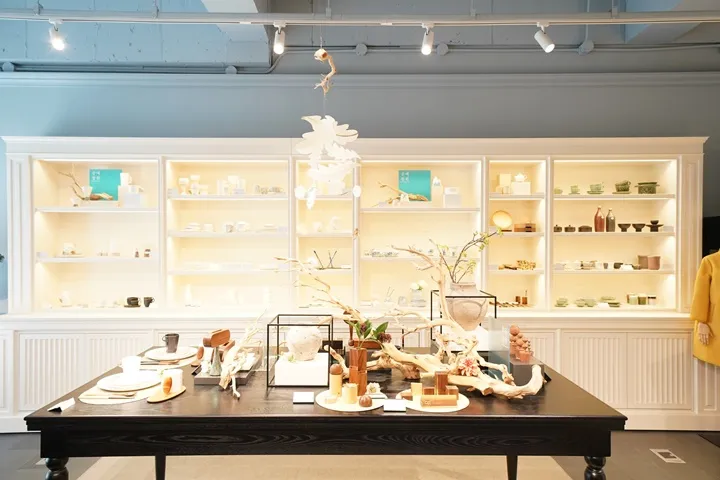
A view of the KCDF Gallery shop floor, as shown on the foundation’s website. Image: Korea Craft & Design Foundation, kcdf.or.kr.
The National Museum of Korea’s shop operator publishes separate hours for its three spaces: Shop 1 runs 09:30–17:30 most days and 09:30–21:00 on Wednesday and Saturday; Shop 2 runs 09:30–17:30 daily; the third-floor MU:DS showroom runs 09:30–17:30 daily with a 12:00–13:00 lunch break. All three close on New Year’s Day, Seollal, Chuseok, and the first Monday of March, June, September and December. Its online catalogue prices a Pensive Bodhisattva miniature at ₩65,000 — the in-museum price isn’t established. A separate English, US-dollar storefront, MU:DS’s global shop, isn’t a conversion of the won catalogue — more on what it ships replicas with, below.
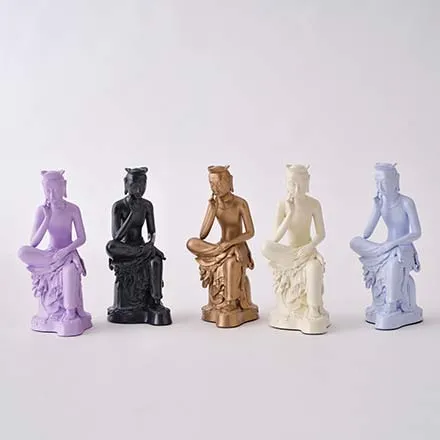
Pensive Bodhisattva miniatures, as shown on the MU:DS online shop. Image: National Museum Foundation of Korea, museumshop.or.kr.
Namdaemun Market appears on Jung-gu’s own tourism page, linked to namdaemunmarket.co.kr, with no hours stated — and older hours for Namdaemun or Insadong’s car-free window trace to uncorroborated 2019–2020 pieces, so aren’t repeated here. Confirm hours at the market itself.
Is the Galaxy S26 actually cheaper bought in Korea?
Checked Tuesday, 2026-09-15 KST, the base Galaxy S26, 256GB, carries three published prices and three tax treatments:
| Store | Price as published | Tax treatment, in the store’s own words |
|---|---|---|
| Samsung Korea (자급제, SM-S942N) | ₩1,254,000 (기준가, store list price) | Not stated on any page read |
| Samsung US (unlocked, SM-S942U) | US$899.99, “From” | Excludes taxes and shipping |
| Samsung UK (SM-S942BZWGEUB) | £879.00 | Includes VAT at the prevailing rate |
Converted at the Bank of Korea’s 2026-09-14 매매기준율 — the most recent rate published when these prices were checked, since no 2026-09-15 row existed yet — US$899.99 comes to roughly ₩1,212,000 and £879.00, at that date’s published rate for pounds (which the Bank doesn’t itself label a base rate), comes to roughly ₩1,600,000, both rounded to the nearest ₩1,000.
On those converted numbers, Korea’s ₩1,254,000 sits about ₩42,000 above the US figure and ₩346,000 below the UK figure — not a “cheaper in Korea” answer. The tax basis differs on every line: the UK figure includes VAT, the US figure excludes sales tax (a state rate not in this number), and Samsung Korea states nowhere checked — the buy page, its price tooltip, footer links, full site terms, or FAQ front page — whether its 기준가 includes VAT. Also, ₩1,254,000 is Samsung Korea’s list price before its own discounts; the UK price advertises a £250 cashback and trade-in not yet subtracted; the US card is a “from” price across colours — none of the three is guaranteed at checkout.
Warranty stays open too: Samsung UK’s support page says international service is repair-only — no replacement, no refund — through a local entity that “may be able to” help, on the purchase country’s terms, possibly slower; whether a Korea-bought S26 qualifies isn’t stated on the Samsung Korea or Samsung US pages this guide read. Treat warranty abroad as unconfirmed — and none of this includes Korea’s own tax refund; see Korea’s tax refund guide.
Packing it: cabin, hold, and a rule that catches people out
Cabin liquids follow one rule for any international departure: 100 ml containers or less, inside a single sealed one-litre transparent zip bag (20.5 × 20.5 cm or 15 × 25 cm) — international-only, per Incheon, with no domestic restriction. Checked bags carry liquids without that limit, including non-flammable sprays, capped at 500 g (500 ml) per item and 2 kg (2 L) total — where a Korean food gift has to go, since gochujang or kimchi in a jar is a liquid or gel by the same rule and clears the cabin only in containers of 100 ml or less. Duty-free liquids are the exception — any volume, sealed in the operator’s own bag, unopened until you board your final flight; no source confirms a connecting airport abroad honours that seal.
Power banks get one agreed rule — two per passenger, 160Wh or less — plus two sources each adding a condition the other skips. Incheon adds that over 100Wh up to 160Wh needs airline approval, which the ministry’s release skips; that release adds that charging a power bank, or using it to charge anything else on board, is banned — which Incheon’s page skips. Both describe the same policy; the 20 April 2026 start date comes from the ministry’s own release — see Korea’s domestic-flight guide for the ministry’s half. Either way, it rides the cabin: Incheon’s Korean page states it isn’t allowed checked. Put the two together and the trap is obvious — a liquid food goes checked, a power bank goes cabin, and reversing either is the likeliest mistake here.
Anything that could be an antique — and anything that just looks like one
Anything that could pass as cultural property needs either an export permit from the Korea Heritage Service’s administrator, or a certificate confirming it isn’t — Incheon and the Heritage Service agree one is required, though not on what to call the certificate, so this describes it by function rather than a name that may already be outdated. The export permit needs at least three months’ notice; an in-person airport appraisal needs at least three hours before departure; an online pre-booked appraisal, at Incheon and Gimpo among 17 airports and ports, needed at least three days’ notice as of a 2015 announcement not re-confirmed since. Exporting cultural property without the permit is punishable by at least three years’ imprisonment.
Incheon’s own pages disagree on where its appraisal office actually is: one names it near check-in counter H on Terminal 1’s third floor, and east of the One-Stop Public Service Centre on Terminal 2’s second floor; another puts it at Gate 8 on the third floor, between F and G. Both carry the same phone number — 032-740-2921 — so call ahead or ask the terminal’s information desk rather than walking to either location.
A replica rather than anything old gets a different document: MU:DS’s global shop ships replicas with what it calls a “Non-Cultural Heritage Certification,” a few days after the order. Neither MU:DS nor Incheon states that a replica bought in person, off a shelf, needs its own appraisal before you fly — this guide isn’t inferring that it does; the two documents just cover different situations.
Korea Customs’ own list of items you must declare on departure doesn’t include ordinary purchases — it names goods you’re re-exporting after a temporary stay, items already held at customs, and cash or payment instruments over USD 10,000. That’s narrower than “you don’t need to declare anything” — it’s what the list covers, not a blanket assurance.
Suitcase, or Korea Post
Korea Post’s EMS base rates, before the additional transport and handling surcharges its own fee calculator adds, run:
| Weight | United States | United Kingdom | Australia |
|---|---|---|---|
| 2 kg | ₩68,500 | ₩55,500 | ₩55,000 |
| 5 kg | ₩128,500 | ₩91,000 | ₩81,000 |
The US is priciest at both weights. Those base rates exclude the surcharge Korea Post’s own calculator adds — this guide couldn’t get a total out of it — so treat the table as a floor, not the counter price. Every parcel is X-ray screened before loading, and a flagged item is returned to the accepting post office, for the sender to collect in person, with postage refunded less a charge.
What this guide can’t answer: whether your skincare, a liquid, a power bank or food clears Korea Post’s own acceptance rules — that list sits inside an image this guide could not read — or whether a lighter K-Packet service suits an individual. Without either, there’s no honest break-even between shipping and carrying it yourself; the rules are here, the comparison isn’t guessed at. If the extra weight is really about the rest of your Seoul day, see storing or shipping a bag inside Korea for moving it before your flight, not out of the country.
What to actually do
Choose the gift from the table before comparing shops. At MU:DS or KCDF, inspect the object and its packaging; at Olive Young, buy for a known skincare preference; at Daiso, decide from the in-store price rather than an assumed price tier. Treat the Galaxy S26 figures as an unfinished comparison until you know the checkout price, tax and warranty. Before paying for food, batteries or an old-looking object, check the relevant baggage or heritage rule above so the gift can actually leave with you.