Checkout is at 11:00. Your flight is at 21:00. Somewhere in those ten hours you have to decide what happens to your bag: carry it, leave it, send it, or check it in early. If you plan to spend the day outside Seoul Station, start with staffed storage or delivery: the AREX pages this guide could read do not settle whether you may leave the station after checking a bag in and return later for the Express. Confirm that procedure with AREX before treating check-in as daytime storage. For one 24-inch suitcase going into storage at 11:30 and coming out at 17:30 on a weekday, carrying it costs ₩0, staffed storage costs ₩8,000, and delivery costs more than three times that. Seoul Station check-in has a comparable ticket premium if you qualify, but it solves the daytime problem only if the exit-and-return procedure works for your plan.
What one bag costs, on one day
| Option | What you pay | The catch |
|---|---|---|
| Carry it | ₩0 | You’re carrying it everywhere in between |
| Leave it — staffed counter (T-Luggage) | ₩8,000 for six hours | Counter closes at 21:00 on the safer reading of two pages that disagree; every extra hour past the four-hour base adds ₩1,000 |
| Hand it over — Seoul Station check-in | No separate fee for the check-in itself | Only if you already hold an AREX Express ticket. Buying one just for this adds ₩8,250 (Terminal 1) or ₩7,650 (Terminal 2) over the All-Stop fare |
| Send it ahead | ₩26,000–₩31,000 to Terminal 2 (T-Luggage), ₩35,200 to either Incheon terminal (Goodlugg), or from ₩30,000 to Terminal 1 (ZIMCARRY) | Priced per bag, not by hours, though T-Luggage charges more at weekends; ZIMCARRY and Goodlugg take the bag from your hotel in the morning, T-Luggage publishes no handover time for a single bag, and Goodlugg’s hotel pickup has to be booked by midnight the day before |
Leaving it and buying an Express ticket just to use the Seoul Station counter land within a few hundred won of each other — ₩8,000 against ₩8,250 at Terminal 1, ₩7,650 at Terminal 2. Sending it costs more than three times the ₩8,000 baseline at every price listed in the table. None of that is a decisive gap on its own; the next two sections are what actually breaks the tie.
Bags per traveller decides more than the price list
Here is the arithmetic no operator publishes, because no operator prices the other one’s service: the Seoul Station premium is charged per traveller — every rider needs their own Express ticket — while storage is charged per bag. Put a party of more than one against more than one bag, using the same weekday staffed-counter rate (₩8,000 per bag) and the same Express premiums, and the two totals pull apart fast:
| Travellers | Bags | Check-in premium (T1 / T2) | Storage | Cheaper by |
|---|---|---|---|---|
| 1 | 1 | ₩8,250 / ₩7,650 | ₩8,000 | within ₩350 either way |
| 2, sharing 1 bag | 1 | ₩16,500 / ₩15,300 | ₩8,000 | storage, by ₩7,300–₩8,500 |
| 1 | 2 | ₩8,250 / ₩7,650 | ₩16,000 | check-in, by ₩7,750–₩8,350 |
| 2 | 2 | ₩16,500 / ₩15,300 | ₩16,000 | within ₩700 either way |
Those rows compare price only. More bags than people makes check-in cheaper, and more people than bags makes storage cheaper. If you are sightseeing after checkout, check-in is useful only if AREX confirms you can leave the station and return later for your train; otherwise choose storage or delivery for the daytime gap. If you were already buying an Express ticket, there is no extra train-fare premium for check-in, but the same exit-and-return question still applies.
The clock is half the answer
- The staffed counter (T-Luggage) opens at 09:00 and, on the safer reading of two pages that price it differently, closes at 21:00.
- ZIMCARRY’s hotel-to-airport delivery wants the bag at your hotel by 10:00 — an hour before an 11:00 checkout — and hands it back at its basement-level Terminal 1 store by the AREX all-stop ticket gates between 15:00 and 22:00.
- The per-bag delivery service to Terminal 2 doesn’t publish its own drop-off window. Its linked package product collects at a city centre between 09:00 and 12:00 and asks you to arrange airport collection at least two hours ahead — 19:00 for a 21:00 flight.
- Seoul Station check-in runs from 05:20, with reception generally closing at 18:50 — but for a 21:00 flight, the counter’s own cutoff falls earlier still: 18:00 at Terminal 1 (three hours before departure) and 17:40 at Terminal 2 (three hours twenty minutes before).
- Gwangmyeong’s counter closes at 17:00, and its own cutoff is 3 hours before departure at Terminal 1 or 3 hours 20 minutes at Terminal 2 — so for this 21:00 flight, 17:00 comes first and binds; for any other flight, work to whichever of 17:00 and your own cutoff is earlier. Reach Incheon at least 1 hour before departure, which is 20:00 for a 21:00 flight.
Only the check-in takes the bag off you for both the train ride and the airport bag drop — that’s this guide’s own reading of the schedules above, not any operator’s claim. Storage hands the bag back before you leave for the airport. Delivery hands it back at the airport, where you still carry it from the delivery counter to your airline’s own desk. One thing is worth flagging rather than assuming: none of the AREX pages this guide could read say whether you can leave Seoul Station again after checking in and before boarding. If you can’t, the check-in only replaces the airport bag drop, and the storage question above still applies to the rest of your day.
Why the cheapest number on the price list isn’t in this comparison
The unstaffed T-Locker network — run by Seoul Metropolitan Rapid Transit Engineering, not Seoul Metro itself — prices a comparable locker at ₩6,400 for six hours — cheaper than the staffed counter’s ₩8,000. It’s left out of the comparison on purpose, and the operator’s own record, read in full, is why. A caution graphic on Seoul Metro’s storage page states, in Korean, that items 50cm or over cannot be stored, without naming which side — a limit that would exclude every suitcase this guide prices, including a 20-inch cabin bag at roughly 55cm. The terms of use that same graphic cites for its own damage payout set the limit differently: an item of 30kg or more, or one bulky enough that the locker door has to be forced shut, with no 50cm or inch figure anywhere in the text. And T-Pass, the operator’s own delivery service, puts suitcases into these same lockers in both directions, up to 32 inches and 25kg a bag. None of the three has been reconciled anywhere on the operator’s own site — the L-size compartment (W 50 × H 90 × D 60 cm) is large enough on paper for a 24-inch bag laid on its side, and the operator’s own delivery arm treats a suitcase as something a T-Locker takes. This guide takes the safer reading anyway — the caution graphic over the terms of use and T-Pass, both of which point the other way — and keeps T-Locker out of the comparison above: the gap between the staffed counter’s ₩8,000 and T-Locker’s ₩6,400 given up for certainty, not for savings. A reader who trusts the compartment size or T-Pass over the caution graphic can make that trade for themselves, now that all three of the operator’s positions are on the table.
One more thing worth knowing if you do use a T-Locker for something genuinely small: how you’re identified depends on which path you use. The app’s sign-up asks for a phone number and a password. The QR path that needs no app identifies you by a device cookie instead, with a recovery email if you give one — its terms name no phone number, and whether the QR payment step itself asks for one wasn’t established on any page checked. No page, in either language, says whether a non-Korean phone number or a non-Korean email address works for either path.
What has to be true before you can check in early
The Seoul Station counter isn’t open to everyone with a suitcase. You need an AREX Express ticket, checked at the gate by its QR code; a same-day international departure from Incheon; and an airline on AREX’s own list for your terminal — Terminal 1 covers Jeju Air, Trinity (code TW, still shown as t’way on some AREX pages) and Eastar Jet, Terminal 2 covers Korean Air, Asiana, Jin Air, Air Busan and Air Seoul, with some exceptions on Americas routes. There is no separate fee for the check-in itself once those boxes are ticked.
The premium this whole comparison rests on is also the number most likely to move. AREX currently posts the Express at ₩13,000 with no stated end date, against a standard fare that its Korean page prints as ₩18,500 at Terminal 1 and ₩19,100 at Terminal 2. Its English page still prints the earlier standard fare, KRW 18,100 and KRW 18,700, and those are the figures an English-page reader sees. If the fare reverts to the Korean page’s standard fare, the premium becomes about ₩13,750 at either terminal — above every per-bag storage figure in this guide, though one traveller with two bags would still pay less to check in than to store both (₩16,000). Check the fare on the day you fly rather than trusting this page’s number by itself; the airport transfer guide carries the same All-Stop and Express fares for the daytime trip in.
If you’re arriving by KTX from outside Seoul rather than starting your day in the city, Gwangmyeong’s check-in counter serves Korean Air, Asiana, Trinity (TW), Jeju Air, Eastar Jet and Jin Air passengers flying internationally from Incheon, not just Express riders — Air Busan and Air Seoul have no counter there. See the KTX versus express bus guide if that’s your route in. For a Seoul-based traveller, though, it isn’t worth the trip on price alone: Gwangmyeong’s own connecting bus to Incheon costs ₩16,000, which is already ₩3,000 more than the Express fare, before you’ve even reached Gwangmyeong.
What isn’t published, and isn’t guessed at here
Four things a traveller might reasonably expect an answer to don’t have one on any operator page checked: what Incheon’s Terminal 2 charges for storage, what Gimpo’s international terminal charges, whether a passenger connecting through Incheon must collect and re-check a bag, and what Korail charges for its own lockers at Seoul Station — which lists three locker sites under two different support numbers, with no operator named for either. None of that is “no fee” or “no service.” It simply isn’t published anywhere this guide could find it, and a price you see for any of them elsewhere didn’t come from the operator.
Leaving the bag at the airport itself sits outside this comparison too — you would need to get there and back before it mattered, which defeats the point on departure day. It matters more on an arrival morning, or during a transfer. If that’s your situation: at Terminal 1 the airport’s directory lists only ZIMCARRY’s counters for storage, and the airport publishes no storage price. For Terminal 2, its English directory lists two Hanjin Express counters with luggage storage among their tasks, one on the 3F west side near Gate 1 (00:00 to 24:00) and one at the west end of the 1F near Gate 1 (07:00 to 21:00); neither card gives a price, and the Korean Terminal 2 listing was not read.
ZIMCARRY’s own pages for its three Terminal 1 stores — two on the 3F and one on the basement level by the AREX all-stop ticket gates — state one flat fee per 24 hours for a suitcase, measured on its longest side: ₩5,000 up to 55cm, ₩8,000 for 56–70cm and ₩10,000 from 71cm. The airport’s directory lists only the two 3F counters. When I checked Terminal 1 on 2 October 2026, the ZIMCARRY counter inside check-in row B on 3F had a fee board showing the same three suitcase prices. The board states no period, so the 24-hour basis rests on ZIMCARRY’s page, not on the board.
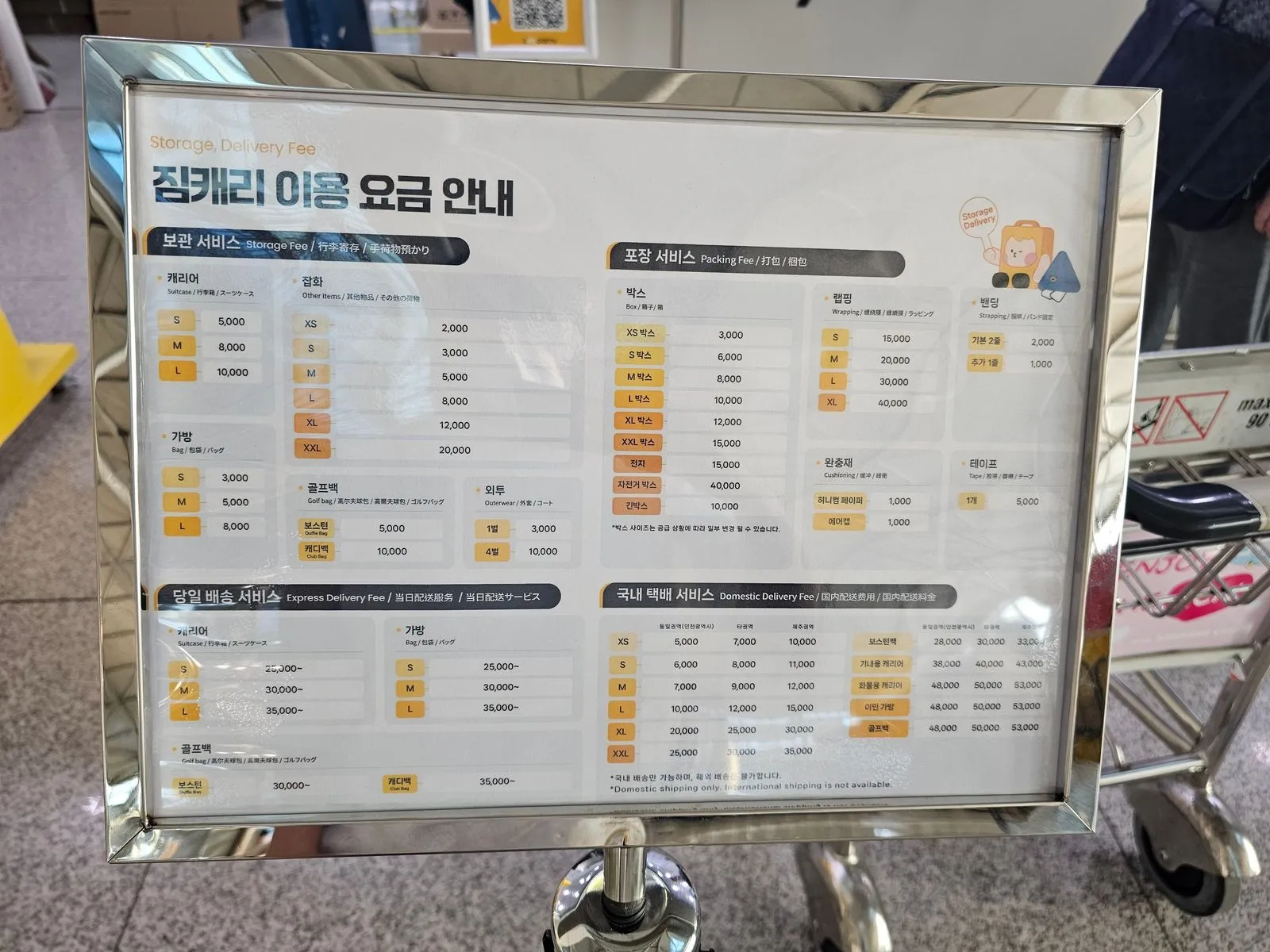
What the ZIMCARRY fee board showed at Incheon Airport Terminal 1 on 2 October 2026. Photograph by the author.
Two sets of hours disagree. For the row-B counter, the airport’s directory says 07:00 to 21:00, while ZIMCARRY’s page says 07:00 to 22:00, and so did the counter’s own sign when I read it on 2 October 2026. Plan to be back by 21:00. For the 24-hour counter near row N, the airport lists 00:00 to 24:00 and ZIMCARRY’s page says 00:00 to 23:50, so treat it as open around the clock except 23:50 to midnight.
Deciding on the day
If you are sightseeing after checkout, book staffed storage and collect the bag before leaving the city, or use delivery if avoiding that collection is worth the extra cost. Consider Seoul Station check-in when your airline and Express ticket qualify and AREX confirms you may leave after check-in and return for your chosen train. Without that confirmation, use it only for the onward airport journey, not as a promise of a bag-free day. The bags-per-traveller table helps compare the prices once those conditions are met.