“Duty free” and “tax refund” get used as if they’re the same thing. They aren’t, and the difference decides which paperwork you need. A 보세판매장 — a bonded sales shop, what “duty free” actually means — sells goods that never carry the tax to begin with, under the customs authority’s own law. An 외국인관광객 면세판매장, an ordinary shop the tax office has designated to serve visitors, charges you VAT and individual consumption tax at the till like it would a resident, then lets you claim that tax back before you leave. Korean names the two 사전면세 and 사후면세 — exempted beforehand, refunded afterward — a distinction English drops entirely. Even Korea Customs Service’s own English page calls the refund shops “duty-free shops,” which is the wrong name for what it’s describing. This guide covers the second scheme: reclaiming tax you already paid, as a departing visitor leaving Korea.
What decides your route from here isn’t preference. It’s arithmetic — how much you spend in one transaction, and the running total of your purchases refunded at the till since you arrived.
Who actually qualifies
The refund decree itself sets no length-of-stay test; it defers entirely to Korea’s foreign-exchange law. The decree does exclude corporations, diplomats stationed in Korea, and UN and US forces personnel and civilian employees stationed in Korea, though the forces exclusion does not apply to purchases at designated shops inside a 관광특구 where forces are stationed. A foreign national counts as a resident — and so falls outside the refund — while engaged in business activity in Korea (국내에서 영업활동에 종사하고 있는 자), or after staying 6 months or more; leaving and spending 3 months or more abroad restores non-resident status. An overseas Korean national is treated as a resident once back in Korea 3 months or more, and returns to non-resident status through three named limbs: business abroad, an international-organisation post abroad, or 2 years or more abroad — a temporary return of up to 3 months still counts toward that clock.
Korea’s tourism board publishes a fourth condition for overseas Koreans, in English: holding permanent residency in another country. The foreign-exchange law the refund decree actually defers to doesn’t contain that condition. Go by the three limbs above — business abroad, an international-organisation post abroad, or two years abroad — not the fourth.
The four amounts that decide your route
Four thresholds do the actual routing — three set directly by the decree, and the ₩15,000 floor set by the ministerial enforcement rule (시행규칙) issued under it.
Nothing qualifies below ₩15,000 in a single transaction, including the tax. Spend at least that in one go at a designated shop, and get the proper 물품판매확인서 (or the refund slip an operator-affiliated shop issues in its place) — a plain receipt does not qualify — and you’re in the scheme.
Under ₩1,000,000 per transaction, and ₩5,000,000 or less in total across your purchases refunded at the till since you entered Korea, the till can refund you immediately, with nothing to collect at the airport. Cross either wall and you’re pushed onto a route that pays out downtown, at the departure airport or after you’ve left instead. Watch the second wall’s arithmetic: five purchases at ₩999,999, all refunded at the till, total ₩4,999,995, leaving only ₩5 of headroom under the trip cap — nowhere near the ₩15,000 floor a sixth purchase would need. Five near-maximum transactions quietly close the at-till route for the rest of your trip. (The decree doesn’t say outright whether that running total is checked before or after the purchase being rung up counts toward it — treat the tighter reading as the one to plan around.)
The wall also bites unevenly on the money itself. On one operator’s published band table, a ₩999,999 purchase returns ₩68,000; a ₩1,000,000 purchase — one won more, and now over the immediate-refund wall — returns ₩75,000. Spending ₩1 more nets ₩7,000 more, because the payout is a flat amount per price band rather than a straight percentage: identical inside a band, and it steps up sharply at the edge. To check a receipt total against Global Tax Free’s published table, or against the most the VAT inside it could return at other operators and at the till, use the Korea tax refund calculator.
Up to ₩6,000,000 per transaction, a downtown or pre-departure operator can pay you before you leave, against a security hold — see below. Past that ceiling, no operator can pay before customs confirms the goods; the money comes only after that confirmation, through the operator or through the shop’s own remittance.
One coincidence worth naming without reading into it: ₩6,000,000 is also where that same operator’s payout table stops using a flat band and starts paying 90% of the VAT instead. Neither the decree nor the operator connects the two — one is a legal ceiling on how a refund can be paid; the other is where an unrelated pricing table changes shape.
Buying something expensive: a second tax can apply
Ordinary purchases carry VAT — Korea’s rate is 10% — and nothing else. But 개별소비세, individual consumption tax, reaches a specific enumerated list of goods, and for part of that list a 기준가격 shields the ordinary price entirely. Jewellery, precious metals and high-grade furs carry no individual consumption tax on the first ₩5,000,000 of an item’s price; high-grade watches, bags and carpets carry none on the first ₩2,000,000. Only the amount above that per-item threshold is taxed, at 20% — not the whole price. A handbag or watch priced at or under ₩2,000,000 bears no individual consumption tax at all. (This is not the Act’s complete list: it also names gaming machines and hunting guns, cars, fuels and tobacco, among other goods. Tobacco and hunting guns are excluded from the refund altogether.)
At the airport: one rule two publishers agree on
Incheon Airport’s own page and Korea Customs Service’s regional customs office publish opposite step orders for the same procedure: the airport has you check in first, then find the kiosk in the departure hall; the customs office’s Korean-language page has you visit the kiosk first, then check in — its English page states no order at all. Neither publisher corrects to match the other, and both are current. What they do agree on, in the customs office’s own instruction, printed in red: the goods go to customs before the bag is checked. Whichever order you end up following, don’t let go of the bag carrying your refund goods until customs has confirmed them — that’s the rule actually deciding whether you keep the refund, not the order of the earlier steps.
Whether an immediate refund taken at the till still requires that same customs stop is where the sources split. One operator’s own page says yes, a purchaser still obtains export confirmation from customs. That same operator’s other page describes departure with no customs step at all. The second operator states plainly that no customs confirmation is needed, because export approval already happens electronically at the moment of payment. The decree points toward going: its departure-confirmation article covers at-till purchases too. Customs may skip the paper 물품판매확인서 when the shop has already sent the electronic immediate-refund record, but it may select which of the goods you present to check against that record (영 제9조②④). The waiver is for the form, not the goods. The article’s first paragraph is worded around tax the visitor bore at purchase, so read it as the decree’s direction rather than a sentence naming your exact case. Allow the time and go to customs anyway — it costs you nothing if it turns out unnecessary.
All of this is Incheon-specific. Gimpo and Gimhae publish an eight-step departure sequence with a generic customs panel and no refund kiosk, counter or hour of their own — nothing here describes what happens if you’re flying out of either.
At Incheon Terminal 1, the airport’s own pages disagree about when the staffed refund counter is open. Its procedure page gives 07:00–22:00 for the counter near Gate 28 on the airside 3F, past security. Its facility directory lists the same counter as 24 hours, and GLOBAL TAX FREE’s operator page says the same. Plan on 07:00–22:00 and don’t count on the staffed counter after 22:00. The airside refund machines near Gate 28 are listed as running 24 hours, so they are the better fallback late at night. Terminal 2’s staffed counter runs 07:00–21:30 — half an hour earlier — and automated machines at both terminals run around the clock. No source publishes how long the refund process itself takes, at either terminal; if you want a staffed counter, treat those counter hours as your real deadline, not as a queue estimate nobody states.
Before security, the airport’s directory lists four tax-refund kiosks on the 3F landside, near check-in rows B, E, J and L, each marked 24 hours. The customs point where refund goods are checked is on the same landside level, not airside near Gate 28. The airport’s directory has no card for it. The only source found that names rows is GLOBAL TAX FREE’s operator page, which puts it at 3F counters E and J, among the landside check-in rows. Both publishers’ step lists put the customs check after the airline has checked you in and tagged the bag, and before the bag is dropped. The one customs card the directory does carry is a separate office in the terminal’s basement, not a departures-level declaration desk, so don’t go there for this check. When I checked Terminal 1 on 2 October 2026, the landside 3F departures board listed a Customs Declaration point among its facilities, but from my photograph I could not read which rows it marks.
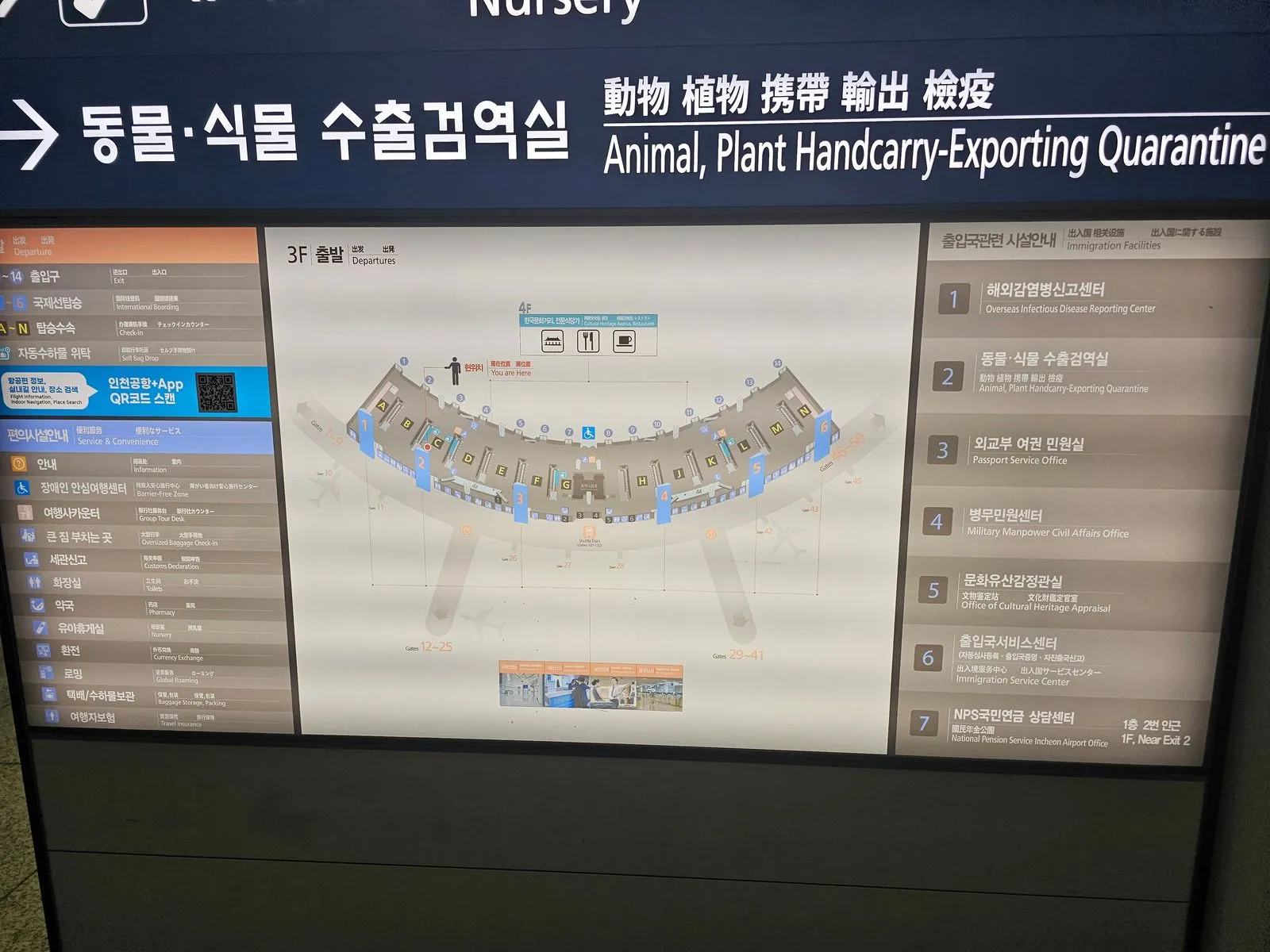
What the departures directory board showed at Incheon Airport Terminal 1 on 2 October 2026. Photograph by the author.
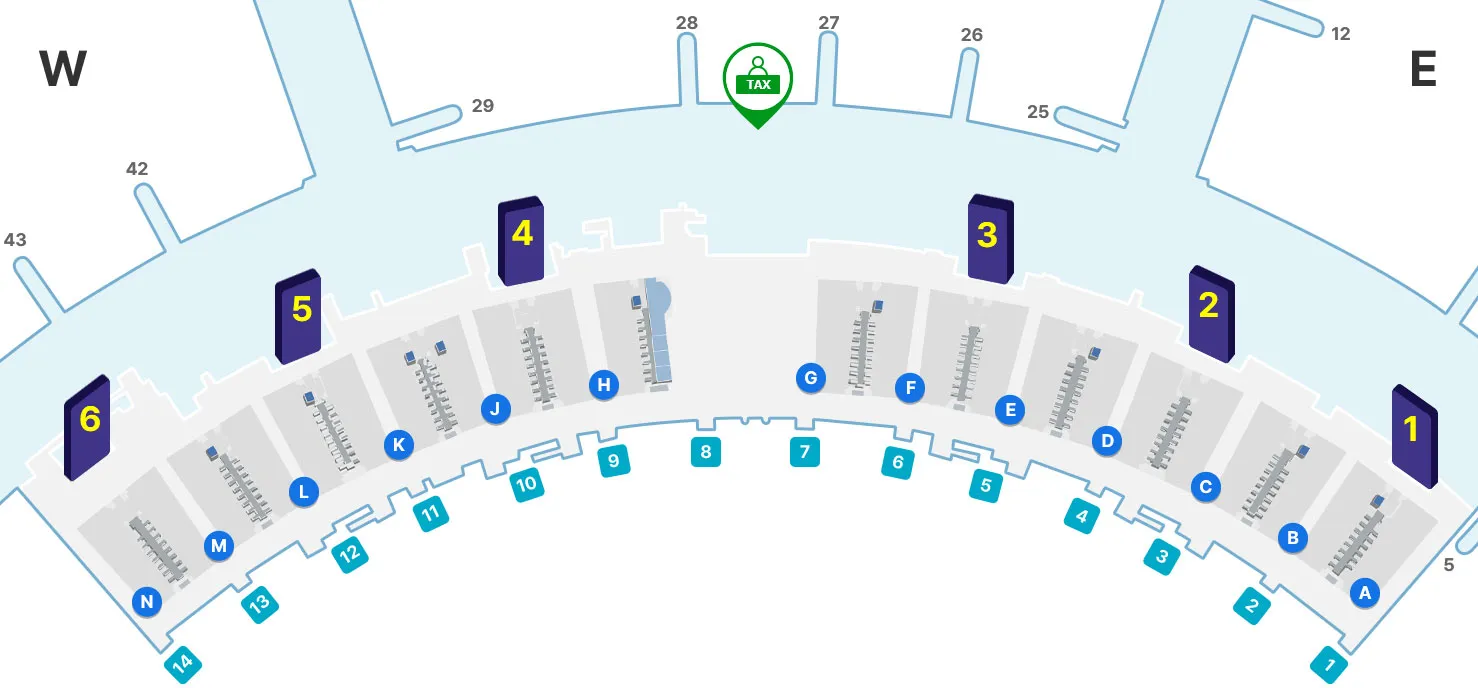
The Incheon Terminal 1 refund counter location map, as shown on the airport’s Domestic Tax Refund page. Image: Incheon International Airport Corporation, airport.kr.
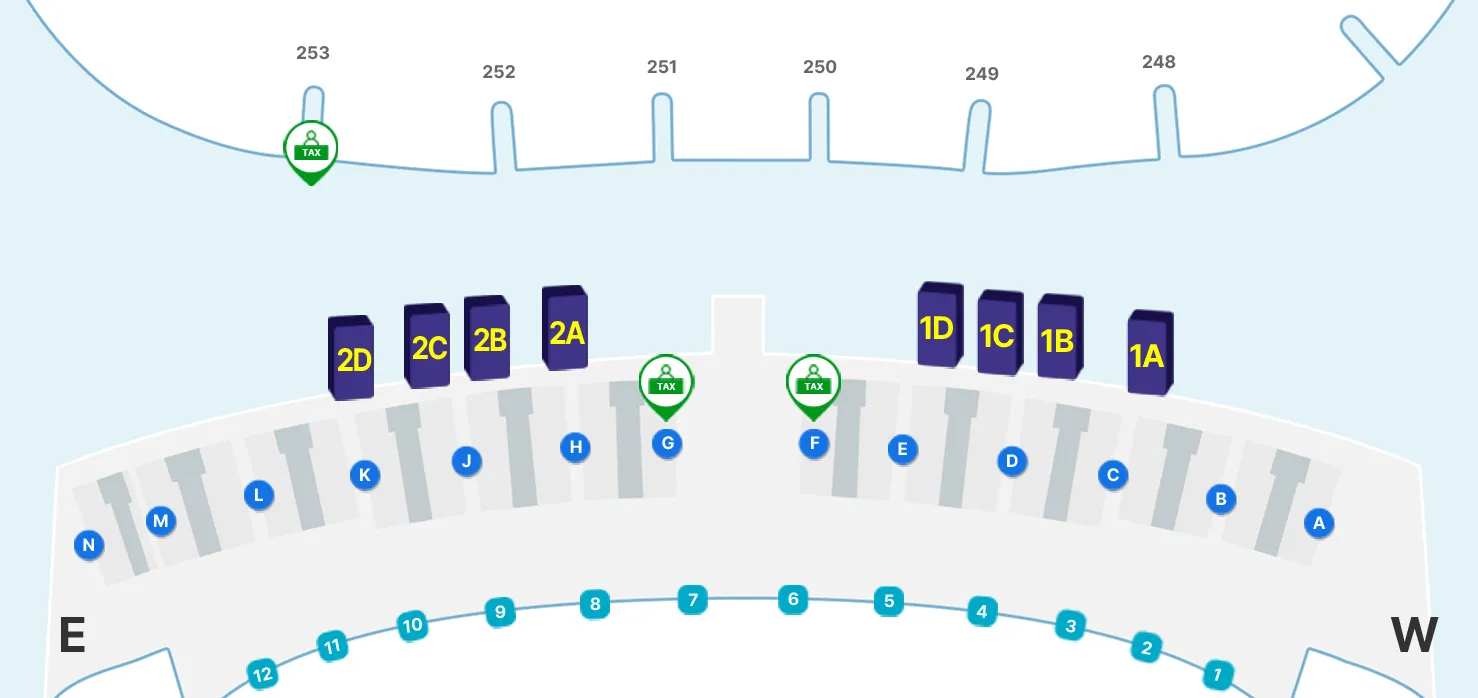
The Incheon Terminal 2 refund counter location map, as shown on the airport’s Domestic Tax Refund page. Image: Incheon International Airport Corporation, airport.kr.
Taking the money before you’ve left
A downtown or pre-departure payout puts cash in your hand before export is confirmed, against security. One operator, GLOBAL TAX FREE, prices that security at 110% of the refund it’s paying you — not of the tax itself, which is the larger figure — so the charge stays inside the decree’s own limit, which caps security at the tax amount being paid out, not at the refund. That operator releases the card deposit automatically once customs confirms export, and its own page states “no customs validation = no refund.” The other operator researched, CubeRefund, states the consequence outright: if the goods aren’t exported, it charges the card security or cancels the refund. Separately, if goods you bought aren’t taken out of Korea within 3 months of purchase, the decree withdraws the at-till route for anything you buy after that 3-month period (영 제6조④). So a missed export can reach past the one refund.
GLOBAL TAX FREE’s own Korean pages don’t agree with each other on this route’s minimum purchase or its deadline — one gives a 25-day clock measured from the refund date, another a 3-month clock measured from the purchase date, with different bands attached to each, and neither page carries a date showing which is current. Go by the paperwork the shop actually gives you rather than by whichever page you found first. And note the whole downtown route here is documented for two of at least five operators active in Korea — a receipt carrying a different company’s mark isn’t covered by the operator-specific figures here (the deposit rate, the bands and the deadlines). The decree’s limits, such as the ₩6,000,000 per-transaction ceiling, apply whichever operator’s mark is on the slip.
Before you fly
Confirm the purchase clears ₩15,000 in one transaction and that you hold the 물품판매확인서 (or an operator-affiliated shop’s refund slip), not a plain receipt. Add up your immediate-refund purchases as you go, and stop relying on the till once you’re near ₩1,000,000 in a single sale or the ₩5,000,000 trip cap. At the airport, find customs before you let go of your bag, whichever order the signage in front of you implies. And if you took money downtown before departure, treat the export-confirmation step as mandatory, not optional — it’s the one thing standing between the refund you already received and keeping it.
If you’re still deciding how you’re paying for any of this in the first place, see Paying in Korea. And if Incheon’s own terminal layout is still unfamiliar, Incheon Airport to Seoul covers the T1/T2 split from the arrival side.