You need two separate answers before you pack: a plug adapter, which every UK, US and Japanese traveller needs, and a voltage answer, which depends on each device. Most of the mistakes happen when the two are treated as one purchase.
The short answer
Korea’s standard supply is 220 V at 60 Hz. The Korea Tourism Organization (KTO) says so in its visitor guide and adds that the outlet has two round holes. Korea’s electricity rules and the national utility, KEPCO, give the same two figures. Both of those are in Korean only.
- Plug adapter: yes, if your plug has flat blades or three blades. Both shapes are covered below. It is also the advice of Korea’s consumer agency, KCA, for any other foreign-standard plug used in Korea, a round-pin one included. KCA’s notice is set out further down.
- Voltage converter: only for a device whose label does not cover 220 V. Check the label rather than your home country.
- Power adapter, meaning the charger for your phone or laptop: that is a different object. It is the thing whose label you read.
An adapter changes the plug, not the voltage
A plug adapter lets your plug reach the socket. It does nothing to the electricity behind it. Electrical Safety First, a UK safety charity, makes the same distinction and points travellers to the rating plate on the device to find out whether it is dual-voltage. The charity is cited for the method only. Every figure on this page comes from an official or manufacturer source.
The KTO page uses the words “multi-voltage travel adapter”. Do not read that as an adapter that converts voltage for you. Treat every socket you find in Korea as a 220 V socket. No source I read says whether any 110 V socket survives in a building today, so I cannot tell you that none do.
Read the label: dual-voltage or single-voltage
Look for the INPUT line on the charger or on the device’s own rating plate. It states a voltage range and a frequency.
- The range covers 220 V and 60 Hz. Apple’s USB power adapters are one sourced example: Apple says they are designed for power sources rated 100 V AC to 240 V AC at 50 Hz to 60 Hz. That includes Korea, so the only thing you need is a plug adapter.
- The range stops short of 220 V. The device is not rated for Korea’s supply, and an adapter alone does not change that. Do not plug it in through an adapter and hope.
- The label lists 50 Hz only. I could not find a source that says such a device runs normally on 60 Hz. Electrical Safety First says only that a device on a different frequency “may work but not properly”. Look for 50/60Hz on the label, and where it is missing, treat the outcome as unknown.
Hair dryers are where people get it wrong. JNTO, writing about Japan, notes that dual-voltage hair dryers, travel irons and shavers exist, so some are safe across countries, but yours is only one of those if its label says so. As general knowledge rather than a sourced finding, phone and laptop chargers are usually dual-voltage and heating appliances often are not. That is a tendency, so the label still decides. I have no sourced guidance on how to size a voltage converter, so this page does not give any. For a single-voltage heating appliance, my advice is to leave it at home.
By where your plug comes from
Apple’s World Travel Adapter Kit page describes its Korea adapter as “round, thick pins”. Its descriptions for the other countries below come from the same page. They are Apple’s own plain-language shapes for its adapters, not a standards classification.
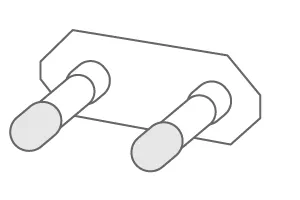
Apple’s drawing of its Korea adapter, which its page labels “round, thick pins”. It shows Apple’s own product, not a standard. Image: Apple Inc., support.apple.com.
From the UK
Apple describes the UK adapter in its kit as “three-prong blades”, a shape that does not fit two round holes, so you need an adapter. The UK declares its supply at 230 V and 50 Hz, a different pair of numbers from Korea’s 220 V and 60 Hz. That is why the label on the device, not the socket at home, decides whether it is safe here. If it lists 50/60Hz and a range that includes 220 V, you need the adapter only.
From the US
Apple describes its North American adapter as “flat, parallel blades with holes”, another shape that does not fit, so you need an adapter. The U.S. Department of Energy gives the US supply as 110–120 V at 60 Hz. The frequency matches Korea’s, but a device labelled only for that voltage range is not rated for 220 V. A phone or laptop charger with a range that includes 220 V is fine with an adapter. A US-only hair dryer is the case to leave behind.
From Japan, or on a Korea and Japan trip
Apple groups Japan with North America under the same flat-blade description, so a Japanese plug needs a Korea adapter as well. Japan’s supply is 100 V, according to JNTO, at 50 Hz in eastern Japan and 60 Hz in the west. A device labelled only for 100 V is not rated for Korea’s 220 V. A device rated for a range that spans both, such as Apple’s 100 V to 240 V chargers, covers both countries.
On a combined trip, a plug that belongs to neither country needs one adapter for Korea’s round pins and one for Japan’s flat blades. JNTO’s mention of a step-down transformer describes using foreign appliances in Japan. Do not carry it over to Korea.
The part no source shows: the socket sits in a well
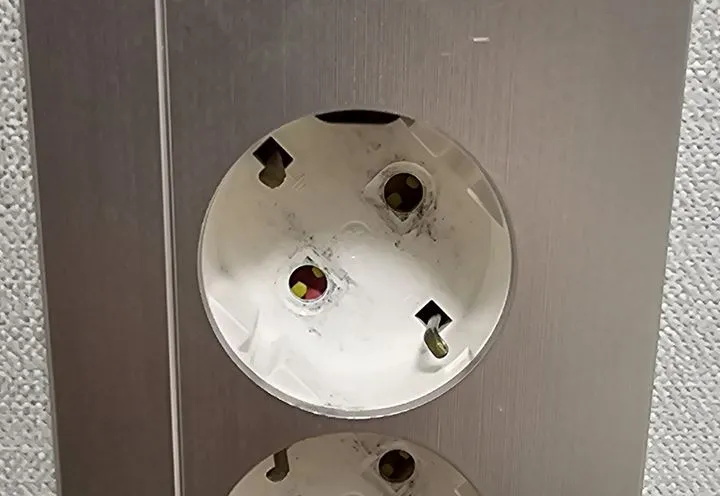
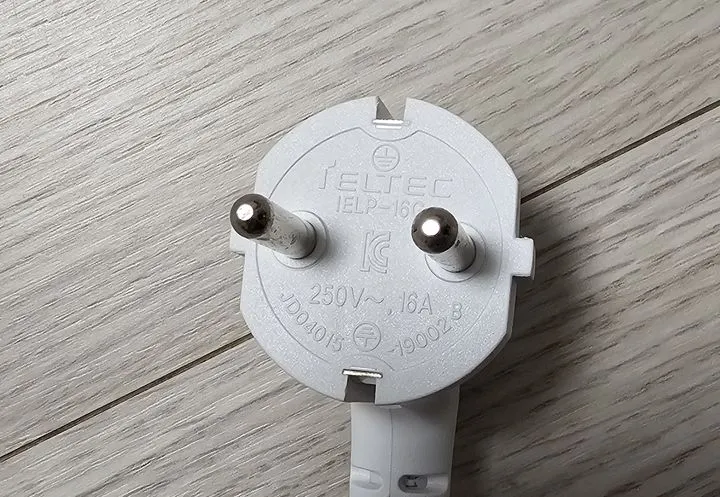
First photograph: the upper socket of a double wall plate in a Seoul home, photographed on 23 September 2026. Second photograph: the face of a Korean two-pin plug. The rating printed on it is that plug’s own, not what the wall delivers. Photographs by the author.
Travel sites describe Korea’s outlet by pin shape and voltage. The first photograph shows something else: each socket sits inside a circular well rather than flush with the plate. A universal adapter with a bulky body, or a plug with a wide collar, may not reach the contacts even when the pins are the right shape and spacing.
Keep the scope in view. That is one socket, in one home, on one date. It is not a claim that every Korean socket is recessed, and no source I read publishes the socket’s dimensions. No adapter has been tested against this socket, by me or, as far as I read, by any source, so the fit problem is an inference from the photograph. The practical reading is to choose a slim adapter, and to check that the plug goes all the way in before you leave a device charging overnight.
One warning from Korea’s consumer agency, at its true width
The Korea Consumer Agency (KCA) published a consumer-safety notice on chargers. It was registered on 29 September 2022 and was still listed on 24 September 2026, with no correction or withdrawal shown. Its finding is narrow, and this page keeps it that way:
- KCA gives the domestic standard for a plug pin as 4.8 mm across.
- It surveyed chargers sold online. One of the four sold by Korean importers was KC-certified and still failed the standard. It was a foreign-standard charger whose pin measured 4.0 mm across at the top.
- KCA says that charger can spark in a Korean socket because of play between pin and socket, and that a heavy charger body can bend pins or lose contact over long use.
- Its advice is to use a plug adapter (변환 플러그) if a foreign-standard product must be used in Korea, and to stop using any device that sparks.
The notice’s subject is foreign-standard plugs used in Korea. Its subtitle reads “해외 규격 플러그가 장착된 전기제품, 국내에서 사용 자제 해야”, which urges people to refrain from using electrical products fitted with foreign-standard plugs in Korea. KCA frames its advice around products bought directly from overseas or through a purchasing agent, and ties the adapter step to using such a product in Korea. That describes any device a visitor brings with a plug from home, so the advice applies to you: where a foreign-standard product has to be used, fit a plug adapter (변환 플러그), and stop using it at once if it sparks. Those are two parts of one piece of advice.
The finding behind it is narrow. It is one product in a 2022 survey. KCA gives no figure for how common thin pins are, and it reports no incident, injury or fire from that charger. It is not a finding about any family of plugs, or about adapters as a class. Do not stretch it into either.
Why this page does not name plug “types”
Most travel sites label Korea’s socket with letters. This page does not, and the reason is worth a line. The International Electrotechnical Commission (IEC) has retired its World Plugs guide. Its index page now reads “The interactive guide to world plugs is no longer available!”, and the pages for Korea and for the individual plug letters returned “Page not found” when I checked on 24 September 2026. IEC tells readers to ask their adapter maker or a travel website instead. The research behind this page turned up no current standards page that assigns a letter to Korea, the UK, the US or Japan, so a letter here would have no source behind it. Shapes, in Apple’s words, are what the sources support.
If you forgot the adapter
KTO’s advice is that a visitor without an adapter may ask to borrow or purchase one from the hotel’s front desk, and that adapters are also sold at the airport, in retail stores, in major duty-free shops and in convenience stores. That is KTO’s suggestion, not a promise that any hotel has a spare or that a loan is free. It says nothing about guesthouses or short-term rentals, so if you are not staying in a hotel, bring your own. Where you sleep changes what you can count on; the accommodation guide covers the options.
What I would pack
- One slim round-pin adapter for each device you cannot otherwise power. Read each charger’s input line before you leave home.
- Nothing for a device whose label covers 220 V and 60 Hz beyond the adapter.
- Leave behind any heating appliance whose label stops short of 220 V, or find out on arrival whether your accommodation can lend one.
If your phone is the thing you are charging, the eSIM and SIM guide covers keeping it connected once it is powered, and the pre-flight app guide covers what to load onto it.