Treat “the palaces” as one schedule and the day will make the decision for you. Gyeongbokgung, Jongmyo and Chilgung close on Tuesdays; Changdeokgung, Changgyeonggung, Deoksugung and Sungnyemun close on Mondays instead. Even within a single month, hours aren’t uniform between sites — in February, Gyeongbokgung’s grounds close at 17:00 with last admission at 16:00, while Changdeokgung’s palace buildings stay open until 18:00 with last admission at 17:00, the same month, an hour apart. All of this sits under one administrator, 궁능유적본부 (Royal Palaces and Tombs Center) of 국가유산청 (Korea Heritage Service), whose own tables this guide is built from — not a averaged summary of them. One nearby site is outside that system entirely: Gyeonghuigung is run by the Seoul Museum of History, and this guide’s research doesn’t reach that source, so it isn’t covered here.
Which day to go
Monday: Gyeongbokgung and Jongmyo only. Changdeokgung, Changgyeonggung, Deoksugung and Sungnyemun are all shut, which also closes Changdeokgung’s Secret Garden and Deoksugung’s Seokjojeon Hall, since both sit inside grounds that are closed. What’s open is Gyeongbokgung, with English tours at 11:00, 13:30 and 15:30, and Jongmyo, which on a Monday runs a timed guided entry only — English sessions at 10:00, 12:00, 14:00 and 16:00, no free-roaming.
Tuesday: the other three, plus the Secret Garden’s first day. Gyeongbokgung, Jongmyo and Chilgung close; Changdeokgung, Changgyeonggung and Deoksugung open. Tuesday is also the first day of the week that Changdeokgung’s Secret Garden and Deoksugung’s Seokjojeon Hall run their English sessions — both operate Tuesday through Sunday, not Monday.
Sunday: the only ordinary day Jongmyo gives you both. Jongmyo admits free-roaming visitors only on Saturdays, Sundays, public holidays and Culture Day; every other open day runs a timed guided visit only, with no wandering. English commentary runs Monday, Wednesday, Thursday, Friday and Sunday — but not Saturday, where the authority’s own English page states plainly that only Korean-language tours run. Put the two lists together and Sunday is the one ordinary day that gives an English-speaking visitor free-roaming access and an English guide together. A weekday buys the guide without the freedom to wander; Saturday buys the freedom without the guide.
Saturday and Sunday: a connecting gate that closes early. Changgyeonggung and Jongmyo share a border, and the gate between them, at Yulgok-ro, opens only on Saturdays, Sundays, public holidays and Culture Day — the same days Jongmyo allows free roaming. It runs its own last-admission time, though, well ahead of the palace’s own: Changgyeonggung’s grounds admit until 20:00 year-round, but the Yulgok-ro gate’s last admission is 17:30 from February to May and September to October, 18:00 from June to August, and 17:00 from November to January. Plan the crossing near the start of your visit rather than the end.
What each site costs to walk in
| Site | Regular closed day | Adult, individual | Adult, group of 10+ |
|---|---|---|---|
| Gyeongbokgung | Tuesday | ₩3,000 | ₩2,400 |
| Changdeokgung (palace buildings) | Monday | ₩3,000 | ₩2,400 |
| Changgyeonggung | Monday | ₩1,000 | ₩800 |
| Deoksugung | Monday | ₩1,000 | ₩800 |
| Jongmyo | Tuesday | ₩1,000 | ₩1,000 — no group rate |
| Sajikdan, Chilgung, Sungnyemun | Tuesday (Chilgung); Monday (Sungnyemun) | Free | Free |
| Deoksugung’s Jungmyeongjeon Hall | Not stated | Free | — |
Two ages get free entry at the five priced sites on a foreign passport: 18 and under, and 65 and over. Korean nationals get the same discount up to 24, which doesn’t apply on a foreign passport — go by the 18-and-under band if you’re travelling on one.
Free doesn’t always mean walk-in. Chilgung is free but runs on booked sessions only, in Korean, and the booking window is nine to three days ahead — the session runs at all only if at least three people have signed up, so a lone visitor can’t secure one. Sajikdan is free too, but the authority publishes no opening or closing time for it anywhere on its site — there’s nothing to plan a visit time around because nothing is stated. And Sungnyemun’s own last-admission time, 17:55, only appears on the Korean-language page; the English page repeats the same opening hours and drops the last-admission figure entirely.
Reserve the Secret Garden before building your day around it
Changdeokgung’s Secret Garden (후원, Huwon) has limited places, and the walk-up allocation can run out — reserve it online before planning the rest of the route if it’s central to your day. Deoksugung’s Seokjojeon Hall also has a limited English session, explained below, with an on-site booking route at the hall’s information desk. Ordinary palace admission is a separate decision.
- It’s a separate ticket from the palace-buildings admission, not an upgrade to it: ₩5,000 for an adult aged 19 to 64, on top of the ₩3,000 palace ticket. The authority’s own English page prints those two figures side by side, not as a total; this guide adds them to ₩8,000. A senior (65 and over) enters the palace buildings free but still pays ₩5,000 for the garden; a visitor aged 7 to 18 pays ₩2,500 for the garden even though the palace-buildings ticket is free to them. There’s no group discount here either.
- Capacity is 100 people per language-guided session, split 50 sold online and 50 sold on site.
- Online booking opens at 10:00, six days before your visit — the visit day itself doesn’t count — and closes at the end of the day before. There’s no same-day online sale.
- Without a booking you aren’t shut out: you’re competing for the 50 walk-up places when the ticket office opens at 09:00 on the day, up to ten tickets per person, and a Secret Garden ticket can be bought as late as fifteen minutes before its session starts.
- Book at ticket.uforus.co.kr — the authority links it three times from its own English Changdeokgung page, so it’s the real booking channel, not a reseller. Two things about it appear nowhere on the authority’s own pages: account signup uses a mobile number as the login ID, and the English booking route accepts VISA, MasterCard and JCB cards issued outside South Korea. If your card’s foreign-currency settings aren’t sorted before you land, see Paying in Korea.
- Being late is fatal rather than merely inconvenient — the authority’s own wording is that late arrival means no entry and no refund.
- The meeting point isn’t the palace gate. It’s the Secret Garden’s own entrance, at least a fifteen-minute walk from Changdeokgung’s entrance (Geumhomun).
- The garden runs its own hours, shorter than the palace buildings’: 10:00 to 17:30 (last admission 16:00) from March to June and September to October, 10:00 to 17:10 (last admission 16:00) in July and August, 10:00 to 17:00 (last admission 15:30) in November, and 10:00 to 16:10 (last admission 15:00) from December to February.
- One area of the garden, Ongnyucheon, is closed for conservation work with no published end date — don’t plan the visit around seeing it.
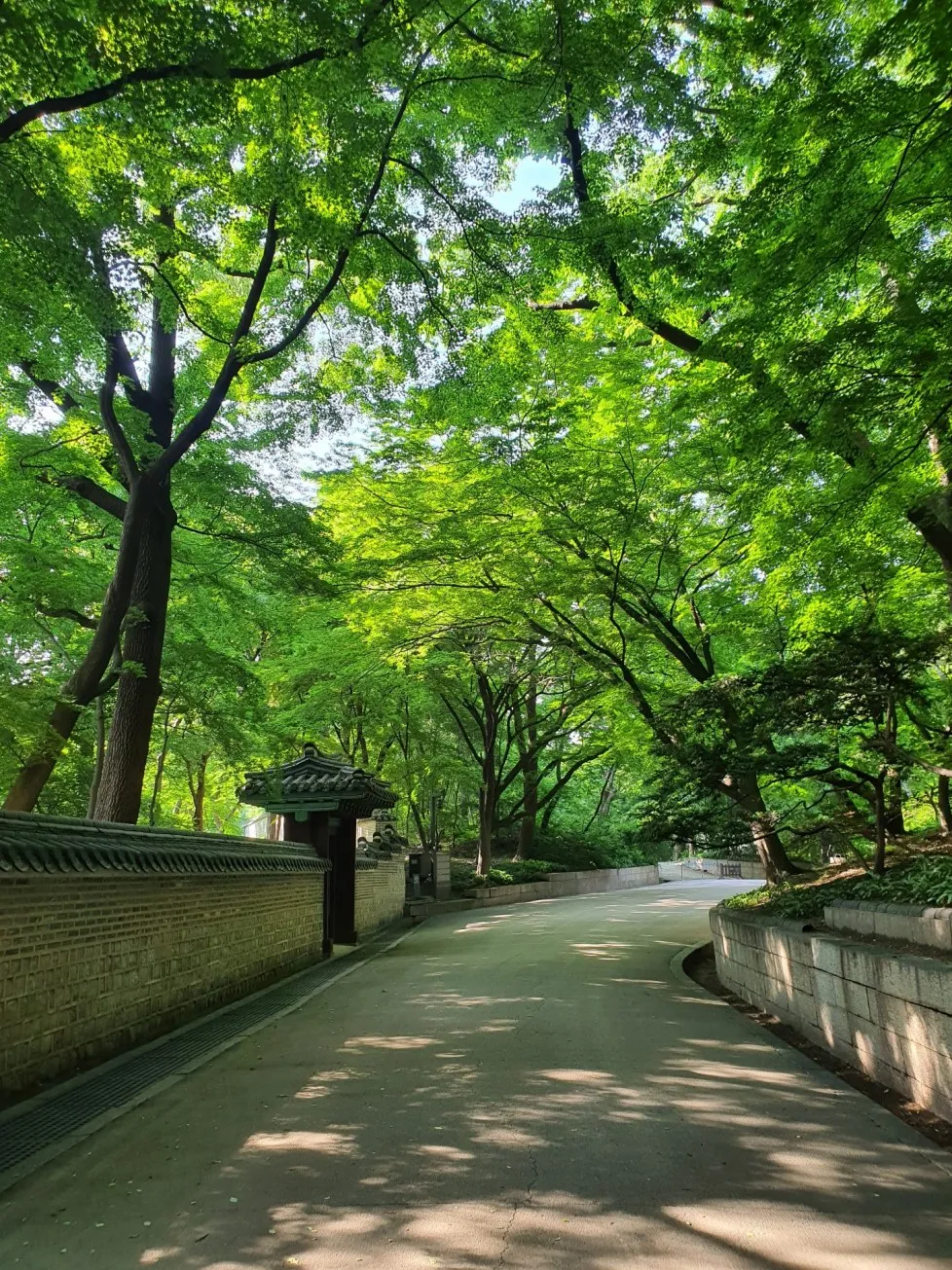
The Secret Garden entrance (후원입구), as labelled on the authority’s Changdeokgung course page. Image: 국가유산청 궁능유적본부 (Korea Heritage Service, Royal Palaces and Tombs Center), royal.khs.go.kr.
What Seokjojeon and a weekday at Jongmyo need — and don’t
Deoksugung’s Seokjojeon Hall is also timed-entry only, and its English sessions are the narrowest of the day — 11:50 and 14:50, Tuesday to Sunday and public holidays. Both on-site rules on the authority’s page cover the English sessions — one allows five walk-up places per session for visitors aged 65 or over and foreign visitors, the other up to 20 at the hall’s desk for foreign visitors — and neither says the English sessions can be booked online. The online places (15 per session, up to five per person, opening one week ahead) are stated without naming a language.
Jongmyo, by contrast, needs nothing arranged from home if your group is under ten people — buy on site, on the day. The authority states this twice, on two separate pages. Groups of ten or more do need to book ahead. Late entry is refused here too.
Gyeongbokgung has nothing to arrange for an ordinary visit — individual visitors under ten join the English tour without booking. Changgyeonggung has even less: no capped area, no timed entry, nothing an individual visitor needs to reserve at all.
Wearing hanbok: what it buys, and where it stops
Anyone in hanbok — Korean or foreign, traditional or the modernised everyday version — gets into Gyeongbokgung, Changdeokgung’s palace buildings, Changgyeonggung, Deoksugung and Jongmyo for free. The authority states its reasoning directly: the exemption exists to popularise hanbok, so nationality plays no part in it.
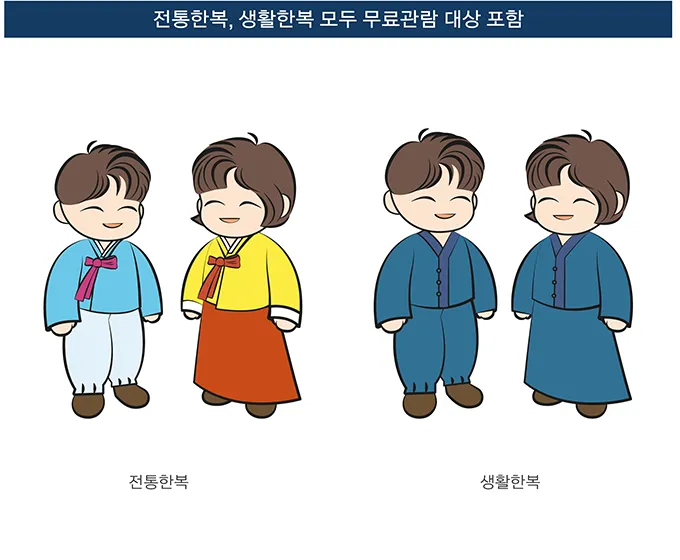
The palace authority’s hanbok guideline pictogram: traditional hanbok (left) and everyday hanbok (right), with the authority’s Korean heading. Image: 국가유산청 궁능유적본부 (Korea Heritage Service, Royal Palaces and Tombs Center), 2023, royal.khs.go.kr, KOGL Type 1.
What qualifies is a jeogori (top) plus a chima or baji (skirt or trousers) — both pieces together, not one alone. The Korean guideline is explicit that how the jeogori fastens doesn’t matter, goreum ties or none at all; the English guideline states the opposite, that the goreum must be fastened. The two language editions contradict each other on this point and neither carries a later date than the other. If you’re renting or improvising, fasten it anyway — that satisfies both readings, and there’s no reason to test the stricter one at the gate. What fails outright, in both languages: a jeogori worn over jeans, or a hanbok bottom worn with an ordinary T-shirt — mixing one hanbok piece with everyday clothing is what actually disqualifies a visitor, not the style of the hanbok itself.
The English guideline’s trouser requirement isn’t published as readable text at all — the row simply reads “The pants are as follows” and points to a diagram this research could not extract any text from, in either language. Treat that requirement as unconfirmed rather than assuming the Korean shape rule carries over to what the English guideline enforces.
Four limits are worth knowing before you dress for it:
- It doesn’t reach the Secret Garden — hanbok buys nothing there, and you still pay the full ₩5,000 (or ₩2,500 for a visitor aged 7 to 18).
- It doesn’t buy a place in anything capped — the Secret Garden, Seokjojeon and Jongmyo’s timed sessions are allocated by booking and arrival order, not by dress.
- It buys nothing extra on whichever day turns out to be a free-admission day — you weren’t paying anyway.
- Proof is required for every free category on the fee page, but unlike the age-based exemptions, which name an ID document, the hanbok line names no document at all. What’s actually checked at the gate isn’t published anywhere this research reached.
The legal basis for the whole exemption sits in an annex — 별표1 of the underlying regulation — that this research could not obtain. What’s summarised here is the fee page’s own restatement of that annex, not its original wording.
The free-admission Wednesday: two authority pages, and they disagree
The standing fee schedule lists one Wednesday a month — the last one, called Culture Day — as a free-admission day across these sites, Secret Garden excluded. Follow the ordinary navigation on either language edition of the site and this is the page you land on.
A separate notice, dated 2026-05-28, announces that free day expanding to every Wednesday instead, phased in site by site: Deoksugung from August 5, Changdeokgung, Changgyeonggung and Jongmyo from October 7 — and Gyeongbokgung with no date attached at all. The notice states only that Gyeongbokgung’s rollout depends on visitor safety and crowding on the ground, with nothing to say when, or whether, it starts.
Both pages belong to the same authority, both were live when this research was checked, and neither carries a revision date that settles which one governs a given Wednesday. Reading it as monthly risks missing a free visit at Deoksugung after August 5. Reading it as weekly risks turning up at Gyeongbokgung — the one site the notice leaves undated — expecting not to pay.
There is no version of this that is safe to guess at in one direction. Before a Wednesday visit, check the notice board on royal.khs.go.kr for the specific site you’re visiting, rather than assuming either rule holds. Bring payment regardless — a wrongly assumed free day costs you a wait at the ticket window, not a missed visit, if you’ve budgeted for the fee either way.
Before you go
Buildings inside these grounds go in and out of closure on notice, separate from the standing hours above — Deoksugung’s Dondeokjeon Hall, for one, was mid-closure when this research was checked. Check the notice board for your specific site the week you travel rather than trusting a fixed list here.
Decide the day first, using the closures above; book the Secret Garden the moment that day is fixed, since its online places stop selling at the end of the day before your visit (Chilgung’s Korean-only sessions close three days ahead); and treat both the hanbok fastening rule and the free-admission Wednesday as open questions to check on the ground, not settled facts to plan around blind. If you’re also sorting where to stay for a trip centred on these five sites, Where to Stay in Seoul covers the areas closest to them.